(https://i0.wp.com/www.biblestudywithrandy.com/wp-content/uploads/2014/07/arad.gif?ssl=1)
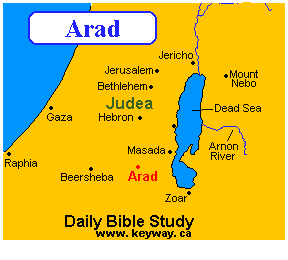
Numbers 21:1-3—1 The king of Arad, the Canaanite, who dwelt in the South, heard that Israel was coming on the road to Atharim. Then he fought against Israel and took some of them prisoners. 2 So Israel made a vow to the LORD, and said, "If You will indeed deliver this people into my hand, then I will utterly destroy their cities." 3 And the LORD listened to the voice of Israel and delivered up the Canaanites, and they utterly destroyed them and their cities. So the name of that place was called Hormah. The people have lost their High Priest Aaron, they have mourned for thirty days, and now they are attacked for simply travelling. Let’s look at a couple of the names here. Arad was a city in the southern part of Canaan, making this the first conflict the people had in the Promised Land. Atharim was not a city; the Hebrew הָאֲתָרִים means, literally, “spies”. In fact, verse 1 is better translated in the ESV When the Canaanite, the king of Arad, who lived in the Negeb, heard that Israel was coming by the way of Atharim… or the KJV And when king Arad the Canaanite, which dwelt in the south, heard tell that Israel came by the way of the spies… So they were going up the same route the spies took in Numbers 13. So The Canaanite king heard they were coming up the same way the 12 went up before, he sent his army out against them and took some of them captives. Then Hormah (חָרְמָה, “devoted”). We saw back in Numbers 14 after the Israelites’ failed attempt to take the land after complaining about the spies’ report. Numbers 14:45—Then the Amalekites and the Canaanites who lived in that hill country came down and defeated them and pursued them, even to Hormah. So what we see here is this: The king of Arad fought against the Israelites, who were coming up the same way as the spies in Numbers 13 and defeated them. The people of Israel, who were slowly learning to trust in the Lord (though not fully, as we will see in a bit) called upon the Lord to deliver this people into their hands—something they should have done before instead of going into battle in their own strength—and this time they defeated the Canaanites and devoted the land to destruction.
I said the people trusted the Lord but not fully. We see that in the next few verses. Numbers 21:4-9—4 Then they journeyed from Mount Hor by the Way of the Red Sea, to go around the land of Edom; and the soul of the people became very discouraged on the way. 5 And the people spoke against God and against Moses: "Why have you brought us up out of Egypt to die in the wilderness? For there is no food and no water, and our soul loathes this worthless bread." 6 So the LORD sent fiery serpents among the people, and they bit the people; and many of the people of Israel died. 7 Therefore the people came to Moses, and said, "We have sinned, for we have spoken against the LORD and against you; pray to the LORD that He take away the serpents from us." So Moses prayed for the people. 8 Then the LORD said to Moses, "Make a fiery serpent, and set it on a pole; and it shall be that everyone who is bitten, when he looks at it, shall live." 9 So Moses made a bronze serpent, and put it on a pole; and so it was, if a serpent had bitten anyone, when he looked at the bronze serpent, he lived. We see, yet again, the people complaining. They wanted God to win their military battles for them, but they did not want to live their lives in accordance with His will. Much like the people in Israel at the time of Christ. They wanted a Messiah who would cast off the shackles of Rome from their feet, but not one who would show them how to live according to God’s will.

(https://biblicalanthropology.blogspot.com/2020/11/tracing-israelites-travels.html)
Then they journeyed from Mount Hor by the Way of the Red Sea, to go around the land of Edom. This would be a long and treacherous journey. And the people did have some right to be discouraged. After all, they had to return south to the Red Sea then go around the land of Edom in order to go north again. This would have added hundreds of miles to their journey. And the land they were trekking through did not have food or water in amounts to sustain the people. So they get a little perturbed and lash out at God and Moses for their troubles. But aren’t we often guilty of that very thing? Don’t we often lash out at God because He puts some kind of obstacle in our lives? We want the road to be smooth and easy, yet God makes it more difficult than we want it to be. And we get mad because our happy little life we wanted for ourselves isn’t so happy for a season. Instead of complaining, we should be trusting God to get us through the very obstacle He has put up.
Don’t be discouraged by these words, my friend, because the Apostle Paul endured the same thing. 2nd Corinthians 12:7—And lest I should be exalted above measure by the abundance of the revelations, a thorn in the flesh was given to me, a messenger of Satan to buffet me, lest I be exalted above measure. Saul of Tarsus was living what many would call “the good life”. He had position, wealth, etc. Everything a person could want. But he did not know Christ. Then Christ met him on the road, and his life got turned upside down. He went from being well-respected among his Jewish peers to being nearly killed by them. But God saw him through it. And Paul could have bragged about it. But rather than allowing him to do so, God put something in his life to teach him humility. A thorn in the flesh. And Paul didn’t like that, 2nd Corinthians 12:8—Concerning this thing I pleaded with the Lord three times that it might depart from me. But just to show Paul that He is who He says He is, Christ tells him in 2nd Corinthians 12:9—"My grace is sufficient for you, for My strength is made perfect in weakness." And that is what God was trying to teach these stubborn Israelites. That He is most glorified when He brings them through trials, and He is more able to display His power by leading them through these difficulties.
But they didn’t want to learn this way. They wanted to go the easy way. They wanted the well-watered plains like Lot. So they complained…yet again. So how does God respond? He sent fiery serpents among the people, and they bit the people; and many of the people of Israel died. They sinned by complaining against God, so God punished them. The words translated as “fiery serpents” is the Hebrew הַנְּחָשִׁים הַשְּׂרָפִים (saraph nahas, “fiery serpents”).We get “seraphim” from saraph. The seraphim of course are angels, like what Isaiah saw in Isaiah 6:1-2—1 In the year that King Uzziah died, I saw the Lord sitting on a throne, high and lifted up, and the train of His robe filled the temple. 2 Above it stood seraphim; each one had six wings… So these serpents were sent by God to bite the people and kill them for their insolence. And what was their only remedy? So Moses made a bronze serpent, and put it on a pole; and so it was, if a serpent had bitten anyone, when he looked at the bronze serpent, he lived. To look on the serpent that was lifted up. Think about this for a minute. They were being pursued by things that could kill them, and to avoid death they had to look upon the thing that was like those things.
Centuries later, that bronze serpent still existed and had never been done away with. Unfortunately, it was being used as a talisman or an idol. 2nd Kings 18:4—He [Hezekiah] removed the high places and broke the sacred pillars, cut down the wooden image and broke in pieces the bronze serpent that Moses had made; for until those days the children of Israel burned incense to it, and called it Nehushtan. By the time of Hezekiah’s reign the worship of God was falling apart, and the people had resorted to worshipping not only Ba'al and Asherah, but also the very thing that saved the people’s lives in the wilderness. They viewed it as a sort of good luck charm; much like the people did the Ark of the Covenant in 1st Samuel 4. They did not see it as simply a tool God used to glorify Himself among the people, but they viewed it as God Himself. Don’t think the worship of icons ended there, as the Romanists have done so with the saints and with the Virgin Mary. They build altars to them, they light candles before them, they offer up prayers to them instead of to the only One who can bring true life. They affix crucifixes to the wall and bow to them, thinking they are doing some great reverence to God, when they are simply carrying on the idol worship that Hezekiah threw down. And don’t think this is limited to the Romanists. We Protestants too often set up pastors and teachers as objects of, if not outright worship, then at least near-worship. Written by Joseph Exell in the 19th Century, The Biblical Illustrator has shed light on the Scriptures for many, and does so here. This is what he has to say about the people’s idolatry that Hezekiah threw down:
There is much idol-breaking to be done in the Church of God. When God gives a man to the Church, fitted for her enlargement, for her establishment, and her confirmation, he gives to her one of the richest blessings of the covenant of grace; but the danger is lest we place the man in the wrong position, and look to him not only with the respect which is due to him as God’s ambassador, but with some degree of—I must call it so—superstitious reliance upon his authority and ability. In the Christian Church there is, I am afraid, at this moment too much exaltation of talent and dependence upon education, I mean especially in reference to ministers. Just the same also may be said of human eloquence. Continuing still our remarks with regard to the Christian Church, I will further remark that much superstition may require to be broken down amongst us in reference to a rigid adhesion to certain modes of Christian service. We have tried to propagate the truth in a certain way, and the Lord has blessed us in it, and therefore we venerate the mode and the plan, and forget that the Holy Spirit is a free Spirit.
Bring that into the future by a few more centuries. We are constantly being pursued by sin. As God told Cain, “If you do well, will you not be accepted? And if you do not do well, sin lies at the door. And its desire is for you, but you should rule over it” (Genesis 4:7). The desire of these fiery serpents was for the people. The desire of sin is you. But as they ruled over the serpents by looking at the one that was lifted up on a pole, so do we rule over sin by the One who was lifted up on a tree. The one who was made like the sin that pursues us. Jesus was made sin by God by having had placed upon Him the sins of His elect. 2nd Corinthians 5:21—He made Him who knew no sin to be sin for us, that we might become the righteousness of God in Him. By His one sacrifice, and by believing in the One who made that one sacrifice, by looking to the Author and Finisher of faith (Hebrews 12:2), we can rule over the sin that pursues us. It was for this reason that our Savior told Nicodemus “And as Moses lifted up the serpent in the wilderness, even so must the Son of Man be lifted up” (John 3:14). And again He says “And I, if I am lifted up from the earth, will draw all peoples to Myself” (John 12:32). “Are you comparing Jesus to a serpent, or sin?” No, but I am saying He was made like that sin. Galatians 3:13—Christ has redeemed us from the curse of the law, having become a curse for us. And all we have to do is look to Him, call upon Him, and we will not die the second death because of the sin that pursues us! “But it takes more than faith. Have you not read that James said faith without works is dead?” Of course I have. And I have written about it here.
Numbers 21:10-20—10 Now the children of Israel moved on and camped in Oboth. 11 And they journeyed from Oboth and camped at Ije Abarim, in the wilderness which is east of Moab, toward the sunrise. 12 From there they moved and camped in the Valley of Zered. 13 From there they moved and camped on the other side of the Arnon, which is in the wilderness that extends from the border of the Amorites; for the Arnon is the border of Moab, between Moab and the Amorites. 14 Therefore it is said in the Book of the Wars of the LORD: "Waheb in Suphah, the brooks of the Arnon, 15 and the slope of the brooks that reaches to the dwelling of Ar, and lies on the border of Moab." 16 From there they went to Beer, which is the well where the LORD said to Moses, "Gather the people together, and I will give them water." 17 Then Israel sang this song: "Spring up, O well! All of you sing to it—18 the well the leaders sank, dug by the nation's nobles, by the lawgiver, with their staves." And from the wilderness they went to Mattanah, 19 from Mattanah to Nahaliel, from Nahaliel to Bamoth, 20 and from Bamoth, in the valley that is in the country of Moab, to the top of Pisgah which looks down on the wasteland.

(https://www.bibleodyssey.org/map-gallery/moab-map/)
Okay, so there are several places here, the majority of which we will not concern ourselves with, but some we will. From there they moved and camped on the other side of the Arnon, which is in the wilderness that extends from the border of the Amorites; for the Arnon is the border of Moab, between Moab and the Amorites. The Arnon is a river that begins in the desert east of the Dead Sea, begins flowing in a northerly direction, then empties into the Dead Sea. Today it is referred to as the Wady Mujib. A wady is an Arabic term for a geographical feature in the Middle East that we would call an “intermittent river”—during the dry seasons it is a dry bed, but flows with water in the other seasons. So two things we can gather from this is (1) they must have crossed during the dry season so as not to be swept away by the current, and (2) they must have crossed in a place where the Arnon was flowing northward, as the Arnon Valley becomes a steep-walled ravine once it makes its turn westward. Moab laid to the south of the Arnon and the Amorites to the north of it. This will become more important in the next few verses following this passage. Currently, however, it still functions as a boundary between two governorates in the nation of Jordan, the Karak and the Madaba Governorates.

(https://biblehub.com/atlas/full/valley_of_the_arnon.htm#google_vignette)
14 Therefore it is said in the Book of the Wars of the LORD: "Waheb in Suphah, the brooks of the Arnon, 15 and the slope of the brooks that reaches to the dwelling of Ar, and lies on the border of Moab." What exactly is this “Book of the Wars of the LORD”? Well, that is a mystery. Many Jewish scholars believe it to be a book of songs sung by the Israelites that were written down to commemorate His victories for the people of Israel over her enemies. Professor Edward Greenstein writes (https://www.thetorah.com/article/what-was-the-book-of-the-wars-of-the-lord) :
Abraham Ibn Ezra (1089-1167) in his commentary suggested that the reference is to an ancient and now lost written source describing the various battles fought by the Israelites against their enemies. R. Joseph Bechor Shor (12th cent.) and Ralbag (R. Levi ben Gershom, 1288-1344) offer the same understanding. That this document is a collection of war and victory songs in which the deity is the hero is also shared by modern scholars such as Jacob Milgrom and Yitzhak Avishur in their Olam HaTanach commentary (ad loc.), and Philip Budd in his Word Bible Commentary (ad loc.) [See, e.g., Philip J. Budd, Numbers (Word Biblical Commentary; Waco, TX: Word, 1984), pp. 238-39.]
We do know that it is mentioned in the extra-biblical and non-canonical Book of Jasher, and is thought to have been compiled by Moses and Joshua. Alas, it is lost to us today. Whatever it was it does give us some insight into how the Pentateuch was formed. It was not a scroll that Moses carried around and wrote down when something happened. It was put together at a later date using smaller written pieces and some oral tradition. Should this be concerning to us? No. For we know that God spoke to the authors of Scripture what to write (2nd Timothy 3:16). If the Bible was nothing but a fabrication of man, it would have included more—and in some places, less—than what we have. But God (I love that phrase!) led the writers of Holy Scripture what to include and what to leave out.
16 From there they went to Beer, which is the well where the LORD said to Moses, "Gather the people together, and I will give them water." 17 Then Israel sang this song: "Spring up, O well! All of you sing to it—18 the well the leaders sank, dug by the nation's nobles, by the lawgiver, with their staves." (Verse 18, KJV—The princes digged the well, the nobles of the people digged it, by the direction of the lawgiver, with their staves). This place Beer (בְּאֵרָה, a well) is not to be confused with Beer-la-hai-roi (בְּאֵר לַחַי רֹאִי, Well of the Living One Seeing Me) mentioned in Genesis as the place where Hagar fled from Sarai. This Beer the people are at now is to the east of the Dead Sea, whereas Beer-la-hai-roi was located to the west of the Dead Sea, between Kadesh and Bered (Genesis 16:14). So they are at a place called “A Well” and they sing a song of celebration, which may also be evidence that they were here in the dry season. And rather than have to have Moses call upon God to provide a miraculous stream of water from the rock or the dry ground, God has already supplied their water from a well. So who are the nation’s nobles referred to here in verse 18? Is it the leaders of Israel, namely Moses and Aaron? Is it the nobles of the land of Moab, or the Amorites? I believe this was dug by the people of Israel by order of Moses from God. This is really the first time when the people have complained about the lack of water, done something about it themselves, and been happy about it.
Part 2 next week