Showing posts with label Balak. Show all posts

11 February 2026

A Survey of the Old Testament Law--Numbers 22-24 (Part 3)

 Numbers 23:25-3025 Then Balak said to Balaam, "Neither curse them at all, nor bless them at all!" 26 So Balaam answered and said to Balak, "Did I not tell you, saying, 'All that the LORD speaks, that I must do'?" 27 Then Balak said to Balaam, "Please come, I will take you to another place; perhaps it will please God that you may curse them for me from there." 28 So Balak took Balaam to the top of Peor, that overlooks the wasteland. 29 Then Balaam said to Balak, "Build for me here seven altars, and prepare for me here seven bulls and seven rams." 30 And Balak did as Balaam had said, and offered a bull and a ram on every altar.

Then Balak said to Balaam, "Neither curse them at all, nor bless them at all!" Still not satisfied and still not convinced that God would not allow Balaam to curse Israel, Balak tells the prophet, in a way, to stay neutral and to not say anything against the people of God. How curious are those who hate the people of God, that they want the people of God to die, and when God does not cause that to pass, they are outraged that God would not destroy His people! Well did David write in Psalm 2:1-31 Why do the nations rage, and the people plot a vain thing? 2 The kings of the earth set themselves, and the rulers take counsel together, against the LORD and against His Anointed, saying, 3 "Let us break their bonds in pieces and cast away their cords from us." The proud boast in their heart that we who have humbled ourselves before the LORD are stupid and weak, that we do not know how to think for ourselves and we blindly follow some Sky Daddy (their term) because we are dumb sheep. Here are some of the things they say about us.

Carl Sagan

You can't convince a believer of anything; for their belief is not based on evidence, it's based on a deep-seated need to believe.

George Carlin

Religion has actually convinced people that there's an invisible man -- living in the sky -- who watches everything you do, every minute of every day. And the invisible man has a special list of ten things he does not want you to do. And if you do any of these ten things, he has a special place, full of fire and smoke and burning and torture and anguish, where he will send you to live and suffer and burn and choke and scream and cry forever and ever 'til the end of time! ..But He loves you... and HE NEEDS MONEY!

Richard Dawkins

The God of the Old Testament is arguably the most unpleasant character in all fiction: jealous and proud of it; a petty, unjust, unforgiving control-freak; a vindictive, bloodthirsty ethnic cleanser; a misogynistic, homophobic, racist, infanticidal, genocidal, filicidal, pestilential, megalomaniacal, sadomasochistic, capriciously malevolent bully.

The nations rage! They claim that the people of God are delusional and that we worship nothing. Or that we worship a man in the sky who wants nothing more than to send us to eternal fiery torment because we wear a shirt made of a cotton/polyester blend. They do not want us to be blessed or cursed—they just want us to be quiet. But…

"Did I not tell you, saying, 'All that the LORD speaks, that I must do'?" What were the Apostles told in the Book of Acts? 27 And when they had brought them, they set them before the council. And the high priest asked them, 28 saying, “Did we not strictly command you not to teach in this name?” (Acts 5:27-28) These Jews were acting more like the Gentiles who opposed God, seeing as how they set themselves up against His Christ. They did not want the Apostles to proclaim the name of Jesus, in direct opposition to the commands they had received from Christ. And what was Peter’s reply? Acts 5:29But Peter and the other apostles answered and said: “We ought to obey God rather than men.” The council no longer spoke for God. The Sanhedrin, even before Christ’s death on the cross, believed they were speaking for God. They handed out judgments as if they were doing so in righteousness and for the glory of God. They held this belief even after it was apparent that God accepted Christ’s sacrifice and they were no longer in charge. But that did not stop them from usurping authority over the people in order to reap the financial rewards. Peter’s reply was a dagger in their heart, although they did not think so. He was telling them that they were merely men, and they were not to be obeyed above the obedience that God requires.

Martin Luther answered the Diet of Worms similarly. They had charged him with speaking against the church and the penalty for that was death. Was he speaking against the church? Only the Roman Catholic “church”. But he was not speaking against Christ’s church. He was not speaking against God or His Christ. He was speaking the truth from the Bible, demonstrating to Pope Leo X and Emperor Charles V that any power does not lay in the bosom of Popes and cardinals, but in the One True God. He did not start out to break away from Rome, but rather to correct their blatantly egregious teachings on Indulgences. But Rome didn’t appreciate someone coming between them and the people’s money, so they pushed and they pushed, and eventually they pushed too far and the Protestant Reformation was born. And in his last statement at the Diet he said these famous words:

Since your most serene majesty and your lordships require of me a simple, clear and direct answer, I will give one, and it is this: Unless I am convinced by the testimony of the Scriptures and by clear reason—for I do not trust in the pope or councils alone, since it is well known that they have often erred and contradicted themselves—I am bound by the Scriptures I have quoted. My conscience is captive to the Word of God. I cannot and I will not retract anything, since it is neither safe nor right to go against conscience. Here I stand. I cannot do otherwise. God help me. Amen.

Who is responsible for the Protestant Reformation? No one but the Roman Catholic system itself! Peter, Martin Luther, Stephen, Jan Hus, and so many others whose blood has become the seed of the church, lived and died by one simple credo: “All that the LORD speaks, that I must do.”
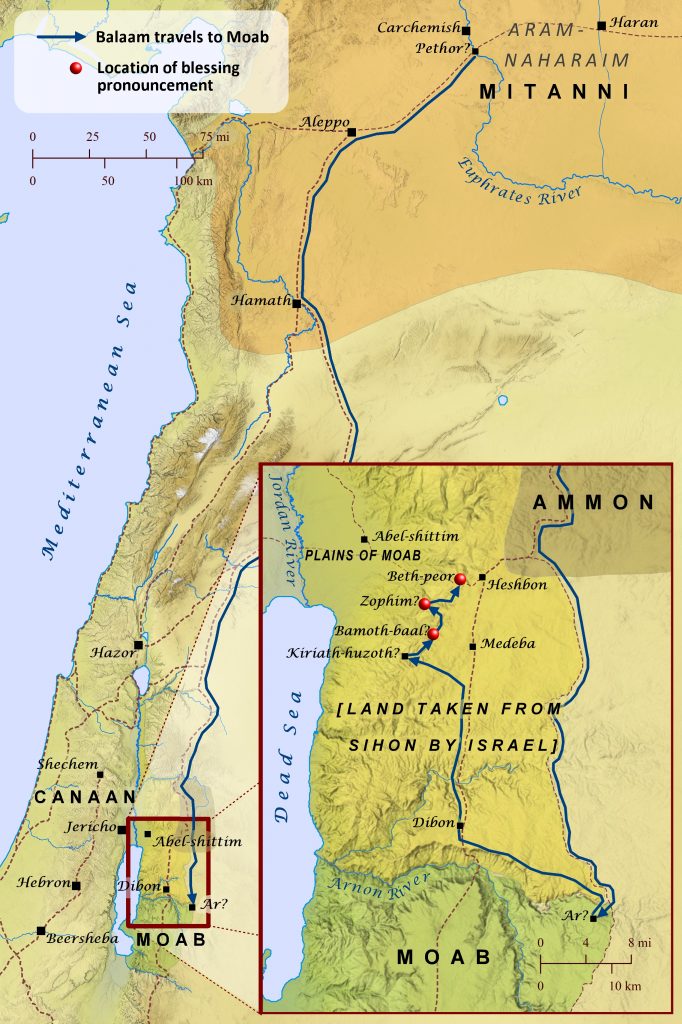


28 So Balak took Balaam to the top of Peor, that overlooks the wasteland. 29 Then Balaam said to Balak, "Build for me here seven altars, and prepare for me here seven bulls and seven rams." 30 And Balak did as Balaam had said, and offered a bull and a ram on every altar. Peor is slightly north-northwest of Pisgah, east of the northern end of the Dead Sea. It is better known by the name Ba'al Peor. It is the place where the people will commit a grievous sin in Numbers 25, but we will look at that when we get there. So Balak builds Balaam seven altars (again) and sacrifices on these altars (again), hoping that this time, his wish will come true. Didn’t happen the first time, didn’t happen the second time. But by golly, this will be the one time it happens! But he couldn’t get it through his head that no matter how many times he tries to get Balaam to curse the people of Israel, God will not let him. Just like when your kids keep asking you for something that will do them harm—and you know it will do them harm, but they don’t know that; they think you are just trying to keep them from having a good time. Balak did not understand that if, instead of trying to curse the people of God, he had simply given then permission to pass through the land, things would have been okay. The only reason the people fought and defeated Sihon king of the Amorites and Og of Bashan was because the people were attacked first. Whenever they came to the border of an area, they sent messengers to ask permission and that they would not turn to the right hand or the left. But, alas, Balak kept at it and kept at it and kept at it. But…

Numbers 24:1-91 Now when Balaam saw that it pleased the LORD to bless Israel, he did not go as at other times, to seek to use sorcery, but he set his face toward the wilderness. 2 And Balaam raised his eyes, and saw Israel encamped according to their tribes; and the Spirit of God came upon him. 3 Then he took up his oracle and said: "The utterance of Balaam the son of Beor, the utterance of the man whose eyes are opened, 4 the utterance of him who hears the words of God, who sees the vision of the Almighty, who falls down, with eyes wide open: 5 How lovely are your tents, O Jacob! Your dwellings, O Israel! 6 Like valleys that stretch out, like gardens by the riverside, like aloes planted by the LORD, like cedars beside the waters. 7 He shall pour water from his buckets, and his seed shall be in many waters. His king shall be higher than Agag, and his kingdom shall be exalted. 8 God brings him out of Egypt; He has strength like a wild ox; He shall consume the nations, his enemies; He shall break their bones and pierce them with his arrows. 9 He bows down, he lies down as a lion; and as a lion, who shall rouse him? Blessed is he who blesses you, and cursed is he who curses you."

This song from Balaam almost reads like one of David’s Psalms or the Song of Solomon. Balaam, too, saw that any effort to curse the people of Israel would not succeed, so instead he speaks this beautiful song. He sees that this is not just a great gathering of people; this is a great gathering of God’s people. And when God’s people are gathered together, it is indeed a great thing! When Christians are gathered together, we are celebrating and giving to God what is due to Him. It is as the first of the Old Testament sacrifices ascending up to Heaven, a sweet aroma to God! Songs and hymns are sung, prayers are lifted up, the Word is preached, and the love of the saints toward God is poured forth, downtrodden ones are lifted up. What could be more blessed! Hebrews 10:24And let us consider one another in order to stir up love and good works. Galatians 6:2Bear one another's burdens, and so fulfill the law of Christ. Romans 10:15 (quoting Isaiah 52:7)—How beautiful are the feet of those who preach the gospel of peace, who bring glad tidings of good things! And our gathering together here on Earth is but a shadow of our eternal gathering in the New Jerusalem! We will be gathered with not only those we know, but those we read about who, through the millennia, have put their trust in God and worship Him as God! We will see Abraham and Jacob; Moses and Aaron; David and Solomon; Matthew, Mark, Luke and John; Peter and Paul; Polycarp and Anselm; Martin Luther and Jan Hus; John Calvin and Theodore Beza; Jonathan Edwards and Charles Spurgeon; John Wesley and George Whitefield; and so many others! And best of all, we will be in the presence of God Himself, and our Lord Jesus Christ. Even those we disagree with on certain matters will be there. George Whitefield and John Wesley were diametrically opposed concerning the issue of predestination versus free will in terms of salvation. When asked if he would see Mr. Wesley in Heaven, Whitefield is quoted as saying (something to the effect of), “No, I won’t. I believe his mansion shall be so close to the throne of God I will not be able to approach it.” May we all be as charitable to those with whom we disagree!

Numbers 24:10-1110 Then Balak's anger was aroused against Balaam, and he struck his hands together; and Balak said to Balaam, "I called you to curse my enemies, and look, you have bountifully blessed them these three times! 11 Now therefore, flee to your place. I said I would greatly honor you, but in fact, the LORD has kept you back from honor." Again, the thinking of the world, that if one follows God and does not have an abundance of the world’s riches that his life is somehow less than ideal. That is the thinking of all the hucksters on TBN who fleece the people for their money, promising them health and wealth and prosperity if they will send these charlatans their money. It also teaches that if there is sickness in your life or your family’s life, or if you are not wealthy (by the world’s standards), your faith is lacking. That’s right. They teach that if your mother gets cancer, it is your fault. This heresy has been promulgated by men (and women) like Oral Roberts, Kenneth Hagin, Paul and Jan Crouch. And what do these also have in common? They’re all dead. Must be they didn’t have enough faith!

Paul’s teachings are directly opposed to this kind of thinking. 2nd Timothy 3:12Yes, and all who desire to live godly in Christ Jesus will suffer persecution. Philippians 4:12I know how to be abased, and I know how to abound. Everywhere and in all things I have learned both to be full and to be hungry, both to abound and to suffer need. 1st Timothy 6:6-106 Now godliness with contentment is great gain. 7 For we brought nothing into this world, and it is certain we can carry nothing out. 8 And having food and clothing, with these we shall be content. 9 But those who desire to be rich fall into temptation and a snare, and into many foolish and harmful lusts which drown men in destruction and perdition. 10 For the love of money is a root of all kinds of evil, for which some have strayed from the faith in their greediness, and pierced themselves through with many sorrows. What should we do instead? 1st Timothy 6:11But you, O man of God, flee these things and pursue righteousness, godliness, faith, love, patience, gentleness. Jesus warned us that as Christians we will not have an easy life. John 16:33“These things I have spoken to you, that in Me you may have peace. In the world you will have tribulation.” When you see Kenneth Copeland or Jesse Duplantis on your TV smiling about how rich they are, remember that it is not God who made them wealthy, but rather the devil. They are rich because they have twisted the word of God to get people to send them the money that has bought their mansions and jet planes.

Numbers 24:12-1912 So Balaam said to Balak, "Did I not also speak to your messengers whom you sent to me, saying, 13 'If Balak were to give me his house full of silver and gold, I could not go beyond the word of the LORD, to do good or bad of my own will. What the LORD says, that I must speak'? 14 And now, indeed, I am going to my people. Come, I will advise you what this people will do to your people in the latter days." 15 So he took up his oracle and said: " The utterance of Balaam the son of Beor, and the utterance of the man whose eyes are opened; 16 the utterance of him who hears the words of God, and has the knowledge of the Most High, who sees the vision of the Almighty, who falls down, with eyes wide open: 17 ‘I see Him, but not now; I behold Him, but not near; a Star shall come out of Jacob; a Scepter shall rise out of Israel, and batter the brow of Moab, and destroy all the sons of tumult. 18 And Edom shall be a possession; Seir also, his enemies, shall be a possession, while Israel does valiantly. 19 Out of Jacob One shall have dominion, and destroy the remains of the city.’" We have spoken of the fates of the Edomites and Moabites HERE and HERE, so let’s move on.

Numbers 24:20-2420 Then he looked on Amalek, and he took up his oracle and said: "Amalek was first among the nations, but shall be last until he perishes." 21 Then he looked on the Kenites, and he took up his oracle and said: " Firm is your dwelling place, and your nest is set in the rock; 22 nevertheless Kain shall be burned. How long until Asshur carries you away captive?" 23 Then he took up his oracle and said: "Alas! Who shall live when God does this? 24 But ships shall come from the coasts of Cyprus, and they shall afflict Asshur and afflict Eber, and so shall Amalek, until he perishes."

Amalek. The first we read about the Amalekites is in Genesis 36:12, where he is listed as a grandson of Esau by his son Eliphaz through his concubine Timna. Which shows that it is not always a good idea to skip the genealogies in the Bible. The Amalekites were the first peoples that the Israelites fought after leaving Egypt. We see them the second time in Exodus 17:8Now Amalek came and fought with Israel in Rephidim. This was the battle where Joshua and Caleb held up Moses’ arms so that God would give them the victory. God tells the people of Israel to wipe them out completely in Deuteronomy 25:19Therefore it shall be, when the LORD your God has given you rest from your enemies all around, in the land which the LORD your God is giving you to possess as an inheritance, that you will blot out the remembrance of Amalek from under heaven. You shall not forget. We read that this is going to happen in 1st Samuel 15, when Saul defeats them once and for all. Unfortunately, Saul makes a bit of a boo-boo in doing so. 1st Samuel 15:1-31 Samuel also said to Saul, "The LORD sent me to anoint you king over His people, over Israel. Now therefore, heed the voice of the words of the LORD. 2 Thus says the LORD of hosts: 'I will punish Amalek for what he did to Israel, how he ambushed him on the way when he came up from Egypt. 3 Now go and attack Amalek, and utterly destroy all that they have, and do not spare them. But kill both man and woman, infant and nursing child, ox and sheep, camel and donkey.'" Samuel had anointed Saul as king over Israel. The people have what they were clamoring for—a king, just like the Gentile nations (1st Samuel 8:5). And for this kingly duty he is to wipe out the Amalekites, man woman and child, for their attack against the people of Israel in Exodus 17. Kill all the people, kill all the cattle and all the sheep and all the goats, everything. And most of all kill their king. Wipe them all out for their attack on the people. But…

1st Samuel 15:7-97 And Saul attacked the Amalekites, from Havilah all the way to Shur, which is east of Egypt. 8 He also took Agag king of the Amalekites alive, and utterly destroyed all the people with the edge of the sword. 9 But Saul and the people spared Agag and the best of the sheep, the oxen, the fatlings, the lambs, and all that was good, and were unwilling to utterly destroy them. But everything despised and worthless, that they utterly destroyed. There is an old saying, that “partial obedience is disobedience”. But Saul didn’t see it that way. He thought he did good by keeping the choice stuff and the king alive, that they could be sacrificed to God. 1st Samuel 15:20-2120 And Saul said to Samuel, "But I have obeyed the voice of the LORD, and gone on the mission on which the LORD sent me, and brought back Agag king of Amalek; I have utterly destroyed the Amalekites. 21 But the people took of the plunder, sheep and oxen, the best of the things which should have been utterly destroyed, to sacrifice to the LORD your God in Gilgal." “I obeyed, it was these people that didn’t!” Sounds familiar, doesn't it? "The woman whom You gave to be with me, she gave me of the tree, and I ate" (Genesis 3:12). “They said to me, 'Make us gods that shall go before us; as for this Moses, the man who brought us out of the land of Egypt, we do not know what has become of him'” (Exodus 32:23). It’s always somebody else’s fault, isn’t it. We can’t take accountability for our own sins, we have to blame someone else.  And that is what Saul does here. It is his own fault and disobedience that the commands of God were not carried out to the fullest, but he blames others, showing that he was a weak-willed and people-pleasing king, instead of the king devoted to God that the people wanted and heeded. John Darby says:

Our excuses, even when true, only condemn us. Saul, not having faith, not looking to God, fears the people more than God. What a slave is the unbeliever! If not the slave of the enemy, he is that of the people whom he appears to govern. Saul, unfaithful to God in the midst of the people, and surrounded by blessings from Jehovah, is at length deprived of the kingdom. No humiliation, no brokenness of heart-he confesses his sin, hoping to avoid its punishment; but, unable to escape it, he entreats Samuel to honour him in spite of it. Samuel does so and then forsakes him. Everything changes now, and David appears on the scene.

And just as Moses was denied entrance into the Promised Land for his disobedience in striking the rock at Meribah-Kadesh (Numbers 20:11-12), so Saul would be removed as king over Israel because of his disobedience here. Obedience to God is no trifling thing. We should not be looking for loopholes when it comes to the things of God, for He is not as one who simply sees the outward things, but sees inside us. Yes it is true, as George Carlin said, that we believe in a God who “who watches everything you do, every minute of every day.” And he would have done well to believe in Him too, for he is now learning that that God is real, that He is not just some “man in the sky” who gives us a wink and a pat on the back when we disbelieve and think of Him as less than who He is. He is finding out that yes, that “man in the sky” will indeed “send you to live and suffer and burn and choke and scream and cry forever and ever 'til the end of time.” If one does not show Him the reverence He is due, that person will also learn that hard lesson.

Numbers 24:25So Balaam rose and departed and returned to his place; Balak also went his way. This is not the last we read of Balaam.  In the next chapter we will see that although he did not pronounce a curse upon Israel, the people were their own worst enemy and fell into idolatry themselves. He did not need to curse them—they could do that themselves, thank you very much. When it says that Balaam rose and departed and returned to his place  it does not mean that Balaam went home. This is better rendered in the International Standard version as Then Balaam got up, returned to his country. For as we will see in Numbers 31, he took some of the Midianites and caused the people of Israel to commit idolatry against God. Keil and Delitzsch say:

It is possible, however, as Hengstenberg imagines, that after Balaam's departure from Balak, he took his way into the camp of the Israelites, and there made known his prophecies to Moses or to the elders of Israel, in the hope of obtaining from them the reward which Balak had withheld, and that it was not till after his failure to obtain full satisfaction to his ambition and covetousness here, that he went to the Midianites, to avenge himself upon the Israelites, by the proposals that he made to them. The objections made by Kurtz to this conjecture are not strong enough to prove that it is inadmissible, though the possibility of the thing does not involve either its probability or its certainty.

We will read more about that when we get there.

Jesus Christ is Lord.

Amen.

04 February 2026

A Survey of the Old Testament Law--Numbers 22-24 (Part 2)

Numbers 22:36-4136 Now when Balak heard that Balaam was coming, he went out to meet him at the city of Moab, which is on the border at the Arnon, the boundary of the territory. 37 Then Balak said to Balaam, "Did I not earnestly send to you, calling for you? Why did you not come to me? Am I not able to honor you?" 38 And Balaam said to Balak, "Look, I have come to you! Now, have I any power at all to say anything? The word that God puts in my mouth, that I must speak." 39 So Balaam went with Balak, and they came to Kirjath Huzoth. 40 Then Balak offered oxen and sheep, and he sent some to Balaam and to the princes who were with him. 41 So it was, the next day, that Balak took Balaam and brought him up to the high places of Baal, that from there he might observe the extent of the people. Balaam was indeed a prophet, one through whom God spoke. And Balak thought Balaam was coming to him to bring him good news that he had cursed the Israelites. So he made a great sacrifice, while at the same time being miffed that Balaam had not come sooner. But what does Balaam tell Balak? "Look, I have come to you! Now, have I any power at all to say anything? The word that God puts in my mouth, that I must speak." Even this pagan spoke only what YHVH put in his mouth. He knew that YHVH was the Almighty God over all creation, and despite living in the pagan land of Moab, he knew that Chemosh could not work the wonders that YHVH could do. Could Chemosh put a message in a prophet’s mouth? Could Chemosh cause a messenger to stand before a donkey and turn him to the side? Could Chemosh cause that donkey to talk? No, he could do none of these things. And Balaam knew this. But YHVH could do these things, and Balaam also knew this. 

This was one of the problems the people of Israel faced in the land where they were. They were beset on every side by nations who worshipped idols. Edom with Qos, and Egypt with its pantheon, to the south. The Amorites to the east with their pantheon. The Hittites with their pantheon and the Ammonites with Molech to the north. The Moabites with Chemosh. The Jebusites with Sedeq and Salem. Then you had the Ba'al worship going on in Canaan, the land they were to settle in. And you can see they were surrounded by pagan worship. And it continued until the days of the early church. The Greeks had their gods, the Romans had theirs (which were just Greek gods co-opted by Rome). Paul would tell the men of Athens, who had built an altar to “An Unknown God”, that they worshipped Him even though they did not know Him (Acts 17:23). It was better, to the Athenian mind, to set up shrines to gods they didn’t know than to offend them by leaving them out of their pantheon.


So it was, the next day, that Balak took Balaam and brought him up to the high places of Baal, that from there he might observe the extent of the people. Much like Satan took Jesus high upon a hill that he may show the Son of God all the kingdoms he would give Him, if only He would worship the serpent of old. Well did our Lord call him “a liar and the father of it” (John 8:44). And here, Balak shows that he too is a liar, showing this man who spoke the truth from God all the land that Balak would rule over if only Balaam would curse the people of Israel. A thought that would be echoed by our Adversary in Matthew 4:9“All these things I will give You if You will fall down and worship me.” Satan is indeed the god of this world (2nd Corinthians 4:4), the Prince of the power of the air (Ephesians 2:2), the Accuser of the Brethren (Revelation 12:10). But that is the limit of his power—this world. He wanted Jesus to lay claim to this world and all its limitations, rather than the Kingdom of His Father, and all the precious souls with it. He wanted Jesus to worship him instead of His Father. Which is what Balak was telling Balaam here. “Don’t listen to what YHVH says. Curse these people and look at all the land we will possess!”


Numbers 23:1-101 Then Balaam said to Balak, "Build seven altars for me here, and prepare for me here seven bulls and seven rams." 2 And Balak did just as Balaam had spoken, and Balak and Balaam offered a bull and a ram on each altar. 3 Then Balaam said to Balak, "Stand by your burnt offering, and I will go; perhaps the LORD will come to meet me, and whatever He shows me I will tell you." So he went to a desolate height. 4 And God met Balaam, and he said to Him, "I have prepared the seven altars, and I have offered on each altar a bull and a ram." 5 Then the LORD put a word in Balaam's mouth, and said, "Return to Balak, and thus you shall speak." 6 So he returned to him, and there he was, standing by his burnt offering, he and all the princes of Moab. 7 And he took up his oracle and said: "Balak the king of Moab has brought me from Aram, from the mountains of the east. 'Come, curse Jacob for me, and come, denounce Israel!' 8 How shall I curse whom God has not cursed? And how shall I denounce whom the LORD has not denounced? 9 For from the top of the rocks I see him, and from the hills I behold him; there! A people dwelling alone, not reckoning itself among the nations. 10 Who can count the dust of Jacob, or number one-fourth of Israel? Let me die the death of the righteous, and let my end be like his!" No matter how many times Balaam went to God to receive a word, it always came back the same. “You shall not curse Israel”. One cannot undo what God has done. We do not have that much power or authority. If God says something is done, it is done. If He says something is going to happen, it is going to happen. We obey kings and presidents because of their position. We yield to law enforcement officers because of the power they hold. If any of these says “so let it be done”, it should be done. How much more should we listen to and obey the Creator of everything! And not only that, should we also not believe Him? He told Abram in Genesis 12:3“I will bless those who bless you, and I will curse him who curses you.” What we see Balaam speak to Balak may not be the extent of everything God said to Balaam. He may very well have included these words He spoke to Abram. 


And God met Balaam, and he [Balaam] said to Him [God], "I have prepared the seven altars, and I have offered on each altar a bull and a ram." So Balaam asked Balak to prepare seven altars. Balak most likely thought they were to be altars to Chemosh, but Balaam meant them for sacrifice to YHVH. Doesn't that so often happen? What the ungodly mean for bad, God turns it around and uses it to fulfill His own plans? Jacob snatching the blessing from Esau. Joseph’s brothers selling him to the Midianites. In fact, after Joseph and his brothers bury Jacob and his brothers think the worst is about to happen and that Joseph will exact revenge, he tells them “But as for you, you meant evil against me; but God meant it for good, in order to bring it about as it is this day, to save many people alive” (Genesis 50:20). And here, what Balak means for evil, God means it for good. 


9 “A people dwelling alone, not reckoning itself among the nations. 10 Who can count the dust of Jacob, or number one-fourth of Israel?” The Apostolic Bible Polyglot renders verse 9: “For from the top of mountains I shall see him; and from hills I shall pay attention to him. Behold, a people alone shall dwell, and among nations they shall not be reckoned together.” The Jewish Publication Society translation says: “For from the top of the rocks I see him, and from the hills I behold him: lo, it is a people that shall dwell alone, and shall not be reckoned among the nations.” Different translations render this verse differently than others, and the divide is about 50/50. This last rendering is closes to the original intent. Balaam had to be on the top of the highest rocky jut to see the vastness of the nearly one million people. Yet this people would live “alone”, as they would be a self-contained group. And they would not be “reckoned among the nations”; they would not be as the other nations, worshipping false gods and being part of their rituals (for the time being, anyway)—they would be holy, set apart to God for His purposes.


“Who can count the dust of Jacob, or number one-fourth of Israel?” “Just one quarter of their population has to be a quarter of a million people! Who can fathom such a great nation!” What was considered to be one of the surest signs of blessing from a deity in the Middle East at this time? Children. So obviously the people of Israel, as the thought went, must have been highly blessed to have had so many children that their numbers would swell, even in the desert. The same could be said of national Israel today. Is there a nation of Hittites? Of Moabites? Of Jebusites or Edomites? All these nations have gone under and exist only in books and in studies of archaeology. Yes, Egypt remains, but the Amorites and Canaanites are gone, save for a few pockets here and there. Yet “Who can count the dust of Jacob?” Did not God tell Abram that his descendants would be “as the dust of the earth; so that if a man could number the dust of the earth, then your descendants also could be numbered” (Genesis 13:16). Next time you go to the beach, pick up a handful of sand. Then count the number of grains of sand, if you are able. That is how numerous the descendants of Abram have been, are, and will be. As I said before, if God says something is going to happen, it’s going to happen.


Numbers 23:11-2411 Then Balak said to Balaam, "What have you done to me? I took you to curse my enemies, and look, you have blessed them bountifully!" 12 So he answered and said, "Must I not take heed to speak what the LORD has put in my mouth?" 13 Then Balak said to him, "Please come with me to another place from which you may see them; you shall see only the outer part of them, and shall not see them all; curse them for me from there." 14 So he brought him to the field of Zophim, to the top of Pisgah, and built seven altars, and offered a bull and a ram on each altar. 15 And he said to Balak, "Stand here by your burnt offering while I meet the LORD over there." 16 Then the LORD met Balaam, and put a word in his mouth, and said, "Go back to Balak, and thus you shall speak." 17 So he came to him, and there he was, standing by his burnt offering, and the princes of Moab were with him. And Balak said to him, "What has the LORD spoken?" 18 Then he took up his oracle and said: "Rise up, Balak, and hear! Listen to me, son of Zippor! 19 God is not a man, that He should lie, nor a son of man, that He should repent. Has He said, and will He not do? Or has He spoken, and will He not make it good? 20 Behold, I have received a command to bless; He has blessed, and I cannot reverse it. 21 He has not observed iniquity in Jacob, nor has He seen wickedness in Israel. The LORD his God is with him, and the shout of a King is among them. 22 God brings them out of Egypt; He has strength like a wild ox. 23 For there is no sorcery against Jacob, nor any divination against Israel. It now must be said of Jacob and of Israel, 'Oh, what God has done!' 24 Look, a people rises like a lioness, and lifts itself up like a lion; it shall not lie down until it devours the prey, and drinks the blood of the slain." 

"Please come with me to another place from which you may see them; you shall see only the outer part of them, and shall not see them all; curse them for me from there." Balak thought that by seeing their entire number, Balaam was afraid to curse Israel for their vast numbers. He thought that if he saw just a tiny fraction of them, he would be more inclined to lay a curse on them. So he takes the prophet to the top of Mt. Pisgah, also known as Mt. Nebo. From here, Balaam could see a small sliver of the people, and Balak thought that here his wishes would come to fruition. But, alas…


“God is not a man, that He should lie, nor a son of man, that He should repent.” So many skeptics and liberals and progressives try to use this verse to say that Jesus was not God. “It says in Numbers that God is not a son of man! How can Jesus be God if He is called ‘The Son of Man’?” The fact that this question even needs to be answered is frustrating. Balaam is not talking here about Jesus. This is not the Book of Mormon where things were written into the text in 1820 in order to fit in with biblical history. Balaam here is talking about the only One the Jews knew as God, that being the Father. Jesus had not been born yet, and would not be for another 1400 or so years. So no, when Balaam said this, Jesus, even though He did exist (John 17:5), had not yet become incarnate and was not, yet, Son of Man. (There is debate about if He was Son of God at this time, but we will leave that to the philosophers). What Balaam is saying here is this: That God is not a man (sorry not sorry, Mormons), and He was not born of a man, but that He has existed forever (Psalm 92:1), that He is dependent upon nobody for His existence, that He does not change His mind 100 times in a day as man does.


“But doesn’t it say in some places, like before the flood and after the repentance of the people of Nineveh, that God repented (Genesis 6:6 (KJV); Jonah 3:10)?” And here we go again. Answering questions from people who have never read or studied the Bible and who do not want anything to do with reading or studying the Bible. Does God know the end from the beginning? Absolutely. Isaiah 46:9-10“9 Remember the former things of old, for I am God, and there is no other; I am God, and there is none like Me, 10 declaring the end from the beginning, and from ancient times things that are not yet done, saying, 'My counsel shall stand, And I will do all My pleasure'” So why would God change His mind? “Then why do we pray?” EM Bounds said in his book “The Reality of Prayer”, 


The law of prayer, the right to pray, rests on sonship. “Our Father” brings us into the closest relationship to God. Prayer is the child’s approach, the child’s plea, the child’s right. It is the law of prayer that looks up, that lifts up the eye to “Our Father, Who art in Heaven.” Our Father’s house is our home in Heaven. Heavenly citizenship and heavenly homesickness are in prayer; Prayer is an appeal from the lowness, from the emptiness, from the need of earth, to the highness, the fullness and to the all-sufficiency of Heaven. Prayer turns the eye and the heart heavenward with a child’s longings, a child’s trust and a child’s expectancy. To hallow God’s Name, to speak it with bated breath, to hold it sacredly, this also belongs to prayer.


Prayer is how we conform our will to God’s will. It is how we seek God for how to live our lives according to the way He wants us to live. It is not so we can get great riches and fame; it is not so we can make a happy life for ourselves according to how the worlds views happiness. True happiness and joy come from being accepted in the Beloved (Ephesians 1:6)—not by health, wealth or prosperity.


“God is not a man, that He should lie.” And of course we know that God cannot—not merely that He does not—lie. He cannot lie (Hebrews 6:18; Titus 1:2). That should be to us the most comforting of all of God’s attributes—that He is faithful and just, even when we are not faithful. We lie, we cheat, we defraud our neighbor. And He knows this. And yet He is patient with us. Oh, the eternal patience of God! We get angry and yell at our children when they misbehave. We get angry when someone cuts us off in traffic. We talk ill of others when they do us wrong. Yet God—they very God to whom we owe our lives—does not cast us aside when we do those things that grieve His heart. In his song “Unchanging One”, Todd Agnew sings:


You know when I wake, when I rise

When I pray, when I curse You

And You love me the same

And You know when I stumble and fall

And You're there through it all

The only Unchanging One


And let’s clear up one more fallacy: The “Ransom Theory” of the Atonement. This is the mistaken belief that God gave up His Son as a payment to Satan to let His people free. This theory says that Adam and Eve’s sin caused all of humanity to belong to Satan, which is far from the truth. According to this theory Jesus’ sacrifice on the cross was a trick played out by God, knowing that Jesus would rise from the dead. God said to Satan that He would give him a sacrifice for our sins, but then He yanked that sacrifice away with the Resurrection. Robin Collins describes it thusly:


“Essentially, this theory claimed that Adam and Eve sold humanity over to the Devil at the time of the Fall; hence, it required that God pay the Devil a ransom to free us from the Devil's clutches. God, however, tricked the Devil into accepting Christ's death as a ransom, for the Devil did not realize that Christ could not be held in the bonds of death. Once the Devil accepted Christ's death as a ransom, this theory concluded, justice was satisfied and God was able to free us from Satan's grip.”


First of all, this theory makes God a liar and deceiver, and He is neither of those things. Second, God owed Satan nothing.  This theory was espoused by Origen, Gregory of Nyssa, St. Basil the Great, and even such great theologians as Athanasius and Augustine. You even see it played out in “The Lion, the Witch and the Wardrobe” by CS Lewis. Here are some quotes from the early proponents of this theory.


Origen:

“But to whom did He give His soul as a ransom for many? Surely not to God. Could it, then, be to the Evil One? For he had us in his power, until the ransom for us should be given to him, even the life (or soul) of Jesus, since he (the Evil One) had been deceived, and led to suppose that he was capable of mastering that soul, and he did not see that to hold Him involved a trial of strength greater than he was equal to.”...“It is clearly shown that a certain spirit, from his own (free) will and choice, elected to deceive, and to work a lie, in order that the Lord might mislead the king to his death, for he deserved to suffer.”


Gregory of Nyssa:


“In order to secure that the ransom in our behalf might be easily accepted by him who required it, the Deity was hidden under the veil of our nature, that so, as with ravenous fish, the hook of the Deity might be gulped down along with the bait of flesh.”


However, William Lane Craig rebuffs this theory (as did the church as of the writings of Anselm in about 1000AD):


“As Origen’s statement revealed, the fathers typically thought of this arrangement between God and Satan as a very clever ruse on God’s part. He tricked Satan into making this exchange. You see, as the second person of the Trinity, the Son of God could not possibly have been held captive by Satan. But by his incarnation – by becoming a man – Christ appeared to be just as weak and vulnerable as other human beings who were under Satan’s control, and it was only after the captives had been freed by Satan that the Son of God manifested his full divine power by rising from the dead and breaking the bonds of death and hell and thus escaping from Satan's power.”


God did not use deceit to buy us out of Hell. His Son came as a substitute for us, paid the penalty we owed, bore the punishment we deserved, and God laid His hands on Him and transferred our sins to Him, and gave us His righteousness. 1st Peter 2:24Who Himself bore our sins in His own body on the tree, that we, having died to sins, might live for righteousness—by whose stripes you were healed. Hebrews 9:28Christ was offered once to bear the sins of many. He bore our sins with His one sacrifice, took His blood into the Holy of Holies in the Heavens, made propitiation for us and cleansed us from all unrighteousness!


Drooping souls no longer mourn/Jesus still is precious;

If to Him you now return/Heaven will be propitious;

Jesus now is passing by/Calling wanderers near Him;

Drooping souls, you need not die/Go to Him and hear Him!

He has pardons full and free/Drooping souls to gladden;

Still He cries—“Come unto me/Weary, heavy-laden!”


Though your sins, like mountains high/Rise, and reach to heaven,

Soon as you on Him rely/All shall be forgiven.

Precious is the Saviour’s name/Dear to all that love Him;

He to save the dying came/Go to Him and prove Him;

Wandering sinners, now return/Contrite souls believe Him!

Jesus calls you, cease to mourn/Worship Him; receive Him.

(“Heaven is Propitious” by Thomas Hastings)


“He has not observed iniquity in Jacob, nor has He seen wickedness in Israel.” “Whoa! What about all the times Israel grumbled in the wilderness and incurred His anger?” Yes, this is a difficult passage on first glance. That is why we do not simply do a cursory reading of Scripture, but exposit it so we can better understand it. This is not talking about individuals, since we have seen in Leviticus all the things that needed to be done to expiate sins and the Day of Atonement. Here Balaam is talking about Israel as a nation—the nation has not turned to other gods, the nation has not cried out to Ba'al or Chemosh. As a nation, Israel is righteous before God, and they belong to Him. Have individuals in the nation sinned? Yes. Have individuals in Israel complained when things didn’t go their way? Yes. Has the nation of Israel ceased to be a nation before Him; has Israel as a nation turned to worship other gods or commit other abominations that the surrounding nations have done? No. That is an important distinction. That of the difference between the nation of Israel and individuals in the nation. So what does this mean for us as Christians? The key phrase we need to remember is “in Christ”. If we are saved, we are in Christ. Romans 8:1There is therefore now no condemnation to those who are in Christ Jesus. 1st Corinthians 1:30But of Him you are in Christ Jesus. Galatians 3:28There is neither Jew nor Greek, there is neither slave nor free, there is neither male nor female; for you are all one in Christ Jesus. Ephesians 2:13But now in Christ Jesus you who once were far off have been brought near by the blood of Christ. John 17:21“That they all may be one, as You, Father, are in Me, and I in You; that they also may be one in Us.” “So we are in Christ; what does this have to do with this passage in Numbers?” Only everything!


God saw no iniquity in the nation of Israel. Does God see any iniquity in Christ? So if we are in Christ, will God see iniquity in us? Were not our sins forgiven as Jesus hung on the tree? Was He not offered up as a substitute for us? Galatians 3:13Christ has redeemed us from the curse of the law, having become a curse for us. 2nd Corinthians 5:17, 21Therefore, if anyone is in Christ, he is a new creation; old things have passed away; behold, all things have become new…He made Him who knew no sin to be sin for us, that we might become the righteousness of God in Him. Jesus Christ, the Son of God, came to Earth, took our sins upon Himself, gave His life and His righteousness to us, and took upon Himself the curse and the sin that was ours. He was not a ransom paid to Satan then snatched away by a deceitful God. He was our Substitute.


Part 3 next week


Jesus Christ is Lord.

Amen.

28 January 2026

A Survey of the Old Testament Law--Numbers 22-24 (Part 1)

Numbers 22:1-61 Then the children of Israel moved, and camped in the plains of Moab on the side of the Jordan across from Jericho. 2 Now Balak the son of Zippor saw all that Israel had done to the Amorites. 3 And Moab was exceedingly afraid of the people because they were many, and Moab was sick with dread because of the children of Israel. 4 So Moab said to the elders of Midian, "Now this company will lick up everything around us, as an ox licks up the grass of the field." And Balak the son of Zippor was king of the Moabites at that time. 5 Then he sent messengers to Balaam the son of Beor at Pethor, which is near the River in the land of the sons of his people, to call him, saying: "Look, a people has come from Egypt. See, they cover the face of the earth, and are settling next to me! 6 Therefore please come at once, curse this people for me, for they are too mighty for me. Perhaps I shall be able to defeat them and drive them out of the land, for I know that he whom you bless is blessed, and he whom you curse is cursed." The next three chapters deal with the prophet Balaam, who was sent by Balak, another king of Moab, to curse Israel. Balak had seen how the people of Israel had defeated the armies of southern Moab, as well as Sihon king of the Amorites and Og of Bashan, and decided war with the people of Israel was not his best course of action. And we will see how even the hiring of Balaam did not work out for him the way he intended.


First, let’s clear up one geographical question. Some translations, even some of the better ones, translate verse one in a manner similar to this: Then the people of Israel set out and camped in the plains of Moab beyond the Jordan at Jericho (ESV). This could give the impression that the people crossed the Jordan River and were encamped at Jericho, which was in the land of Canaan. This could thus lead to the question, “If God told Moses he would not enter the Promised Land, then why did he wind up in Jericho, which is in Canaan?” That would be a good question. This is a matter of translation, and there are some translations that render it better than others. The NASB renders Numbers 22:1Then the sons of Israel journeyed, and camped in the plains of Moab beyond the Jordan opposite Jericho. The Bishop’s Bible says And the children of Israel departed and pitched in the fieldes of Moab, on the other side of Iordane from Iericho. The God’s Word Bible renders it Then the Israelites moved and set up camp across from Jericho, on the plains of Moab east of the Jordan River. Suffice to say, the people of Israel were still on the east side of the Jordan River, in the northern part of the land of Moab. Kinda like Point Roberts, WA. It is part of the state of Washington, and within the borders of the United States. But it is separated from the rest of the state by the Strait of Georgia, and there is no ferry service across the strait. So to get from Point Roberts to Seattle, you must first cross into Canada, then back into the United States. 

 The Expositor’s Bible describes the land:


While a part of the army of Israel was engaged in the campaign against Bashan, the tribes remained "in the plains of Moab beyond the Jordan at Jericho." The topography is given here, as elsewhere, from the point of view of one dwelling in Canaan; and the locality indicated is a level stretch of land, some five or six miles broad, between the river and the hills. In this plain there was ample room for the encampment, while along the Jordan and on the slopes to the east all the produce of field and garden, the spoil of conquest, was at the disposal of the Israelites. They rested therefore, after their long journey, in sight of Canaan, waiting first for the return of the troops, then for the command to advance; and the delay may very likely have extended to several months.


And since they were stationed along the banks of the Jordan River, guess what else they had? WATER! They wouldn’t have to complain about having water, for it was there for the drinking, running, living water! 


2 Now Balak the son of Zippor saw all that Israel had done to the Amorites. 3 And Moab was exceedingly afraid of the people because they were many, and Moab was sick with dread because of the children of Israel. Just as I said last time about the people of Jericho learning of how mighty was the God who fought for Israel, so first Balak and the people of the Moabite plains were sore afraid of Him. So rather than use a military strategy against them, Balak devised a stratagem based on their following God. He would hire a prophet to curse them and stave off an invasion by Israel. They did, indeed, fear God. There was a fear of God before their eyes. And if they had approached Moses and submitted themselves to YHVH, and kept His commandments, they would have had peace. But how often do those who do not want to submit to God find ways to oppose Him and store up wrath for themselves?


Numbers 22:7-147 So the elders of Moab and the elders of Midian departed with the diviner's fee in their hand, and they came to Balaam and spoke to him the words of Balak. 8 And he said to them, "Lodge here tonight, and I will bring back word to you, as the LORD speaks to me." So the princes of Moab stayed with Balaam. 9 Then God came to Balaam and said, "Who are these men with you?" 10 So Balaam said to God, "Balak the son of Zippor, king of Moab, has sent to me, saying, 11 'Look, a people has come out of Egypt, and they cover the face of the earth. Come now, curse them for me; perhaps I shall be able to overpower them and drive them out.'" 12 And God said to Balaam, "You shall not go with them; you shall not curse the people, for they are blessed." 13 So Balaam rose in the morning and said to the princes of Balak, "Go back to your land, for the LORD has refused to give me permission to go with you." 14 And the princes of Moab rose and went to Balak, and said, "Balaam refuses to come with us." Moab entered league with Midian, a tribe which was located to the southwest of the Dead Sea. The thought, I suppose, was to box Israel in between the two nations and, once (so they thought) the Israelites were cursed, it would be no great things to defeat them. About that whole “cursing Israel” thing…


Balaam was indeed a prophet, even a prophet who was recognized by God. And here we see that Balaam, although a Moabite and hired by the Moabite king to curse Israel, does not initially go against the word of God. The princes of Balak offer him a large sum of money to call down a curse upon Israel. But what is his response, after talking with God? And notice, there is no hint of insolence in Balaam’s words when he is talking with God. He tells the princes "Go back to your land, for the LORD has refused to give me permission to go with you." For any rational human being, this should have been the end of things. But calling Balak rational would not be a correct assessment of his mental state. Had the people of Israel made any kind of threatening movement towards him? No. They were simply hanging out by the Jordan River, waiting to cross it into Canaan. But Balak didn’t care, he wanted them gone. But he was afraid to engage them in combat after they had destroyed Sihon and Og. So now, since Balaam has returned and told him that he could not curse Israel, he starts to panic a bit.


Numbers 22:15-1915 Then Balak again sent princes, more numerous and more honorable than they. 16 And they came to Balaam and said to him, "Thus says Balak the son of Zippor: 'Please let nothing hinder you from coming to me; 17 for I will certainly honor you greatly, and I will do whatever you say to me. Therefore please come, curse this people for me.'" 18 Then Balaam answered and said to the servants of Balak, "Though Balak were to give me his house full of silver and gold, I could not go beyond the word of the LORD my God, to do less or more. 19 Now therefore, please, you also stay here tonight, that I may know what more the LORD will say to me." So after he has told Balak that he cannot curse Israel because God prevented him from doing so, Balak doubles down and sends even more princes and more money to him, in an effort to persuade Balaam to transgress against what God has said. But again, Balaam stands his ground and says even if Balak offered all of his wealth, he cannot go against God. So he tells the princes to stay the night with him again while he goes and talks to God. And I suppose Balaam could have sent away the princes and been done with the whole matter, but we see how he equivocates and even (perhaps) hopes that God will give him a different word. As if he was perhaps double-minded.  James 1:8 (KJV)A double minded man is unstable in all his ways. And Balaam will find that out next.


Numbers 22:20-2220 And God came to Balaam at night and said to him, "If the men come to call you, rise and go with them; but only the word which I speak to you—that you shall do." 21 So Balaam rose in the morning, saddled his donkey, and went with the princes of Moab. 22 Then God's anger was aroused because he went, and the Angel of the LORD took His stand in the way as an adversary against him. And he was riding on his donkey, and his two servants were with him. Now this is a confusing passage. In verse 19 God says to Balaam to go with the princes, then in verse 20 He is angry because he went with the princes. So something must have happened between God telling him to go with the princes and him actually going with the princes. The best hypotheses I have seen say that in this meantime Balaam took the money from the princes and this was the reason for God’s anger. Which would make sense of 3 New Testament verses which paint Balaam in a less-than-favorable light. 2nd Peter 2:15They have forsaken the right way and gone astray, following the way of Balaam the son of Beor, who loved the wages of unrighteousness.  Jude 1:11Woe to them! For they have gone in the way of Cain, have run greedily in the error of Balaam for profit, and perished in the rebellion of Korah. Revelation 2:14“But I have a few things against you [the church at Pergamos], because you have there those who hold the doctrine of Balaam, who taught Balak to put a stumbling block before the children of Israel, to eat things sacrificed to idols, and to commit sexual immorality.” FB Meyer wrote that:


If only Balaam had abided by his first answer to Balak’s request, he would have been saved from the disgrace and suffering which ensued. But he seemed to think that it was possible to alter God’s mind; hence his request to the second company of messengers that they give him time to ascertain God’s will. Already that will had been clearly made known to him; what object had he in pressing for a further response? When, finally, he was told that he might go, he rose up in the morning, saddled his ass, and started post-haste. He was trying to serve two masters-to speak as God bade him, but to please Balak and pocket his gold. How many agencies God uses to arrest our evil courses! Peter specially refers to this incident. Many cries are raised to stop the boat that is caught in the rapids above Niagara! Thus the way of transgressors is made hard by the love of God!


CI Scofield:

In Numbers 22:12 the directive will of Jehovah is made known to Balaam, in Numbers 22:20 Jehovah’s permissive will. The prophet is now free to go, but knows the true mind of the Lord about it. The matter is wholly one between Jehovah and His servant. The permission of Numbers 22:20 really constitutes a testing of Balaam. He chose the path of self-will and self- advantage, and Jehovah could not but gravely disapprove. The whole scene, Numbers 22:22-35 prepared Balaam for what was to follow.


So yes, God allowed him to go, but did not want him to go. He already had his answer once, but allowed himself to be played along with wealth. How many times does God need to say something for it to be true? But he stepped further away from the commands that God had given him. It is no different for many people today, who creep away from the fences God has put up to keep us away from sin. Hebrews 1:13-2:11 But to which of the angels has He ever said: "Sit at My right hand, Till I make Your enemies Your footstool"? 14 Are they not all ministering spirits sent forth to minister for those who will inherit salvation?  2:1 Therefore we must give the more earnest heed to the things we have heard, lest we drift away. Let us always hold fast the words given to us, lest we slide away, by little and little, away from the goodness of God.


Numbers 22:23-3323 Now the donkey saw the Angel of the LORD standing in the way with His drawn sword in His hand, and the donkey turned aside out of the way and went into the field. So Balaam struck the donkey to turn her back onto the road. 24 Then the Angel of the LORD stood in a narrow path between the vineyards, with a wall on this side and a wall on that side. 25 And when the donkey saw the Angel of the LORD, she pushed herself against the wall and crushed Balaam's foot against the wall; so he struck her again. 26 Then the Angel of the LORD went further, and stood in a narrow place where there was no way to turn either to the right hand or to the left. 27 And when the donkey saw the Angel of the LORD, she lay down under Balaam; so Balaam's anger was aroused, and he struck the donkey with his staff. 28 Then the LORD opened the mouth of the donkey, and she said to Balaam, "What have I done to you, that you have struck me these three times?" 29 And Balaam said to the donkey, "Because you have abused me. I wish there were a sword in my hand, for now I would kill you!" 30 So the donkey said to Balaam, "Am I not your donkey on which you have ridden, ever since I became yours, to this day? Was I ever disposed to do this to you?" And he said, "No." 31 Then the LORD opened Balaam's eyes, and he saw the Angel of the LORD standing in the way with His drawn sword in His hand; and he bowed his head and fell flat on his face. 32 And the Angel of the LORD said to him, "Why have you struck your donkey these three times? Behold, I have come out to stand against you, because your way is perverse before Me. 33 The donkey saw Me and turned aside from Me these three times. If she had not turned aside from Me, surely I would also have killed you by now, and let her live." 


Do you not find it odd that Balaam answered his donkey when it spoke to him as if it were a natural thing? Think about it. You’re riding along the path on your donkey, it bucks against you, so you strike it. Then the third time you strike it, the donkey turns around and begins talking to you. And you answer! This is one of those places where the skeptic discards the Bible. “A talking donkey! And in Genesis a talking snake?? Nope, not gonna believe this! Next thing you’re gonna tell me an angel slew 200,000 soldiers in one night!” That is because they do not want to believe in a God that can do things in His Creation that we as humans do not understand.


Neil deGrasse Tyson is probably the most famous scientist of our day. And although he does not classify himself as an atheist (he calls himself an agnostic) and consistently argues against the existence of God. He has said in the past, “‘God’ is an ever-receding pocket of scientific ignorance that's getting smaller and smaller and smaller as time moves on.’” But did the scientists like Michael Faraday and Johannes Kepler not believe in God simply because they were scientists? No. Kepler wrote, “The chief aim of all investigations of the external world should be to discover the rational order and harmony which has been imposed on it by God and which He revealed to us in the language of mathematics.” These were men upon whose shoulders Neil deGrasse Tyson purports to stand. But he says of them, “They [scientists of centuries past] call on God only from the lonely and precarious edge of incomprehension. Where they feel certain about their explanations, however, God gets hardly a mention.” Almost mocking them for their faith. But that’s what he does. But these men knew the truth and sounded forth the truth of Psalm 19:1The heavens declare the glory of God; and the firmament shows His handiwork. But alas, The fool has said in his heart, "There is no God" (Psalm 14:1). And here is Balaam arguing with his donkey, knowing that it was God who was speaking through his donkey. And let us remember the words of our Lord. Luke 19:39-4039 And some of the Pharisees called to Him from the crowd, "Teacher, rebuke Your disciples." 40 But He answered and said to them, "I tell you that if these should keep silent, the stones would immediately cry out." And you could say the donkey was smarter than Balaam in this instance. The donkey saw the Angel of the Lord, and bowed himself to it. Well did Isaiah say in Isaiah 1:3“The ox knows its owner and the donkey its master's crib; but Israel does not know, My people do not consider.”


But we could probably cut Balaam some slack as he did not see the Angel in the road. Then the LORD opened Balaam's eyes, and he saw the Angel of the LORD standing in the way with His drawn sword in His hand; and he bowed his head and fell flat on his face. How many times do we see in the Scriptures that God opens people’s eyes to see what is right in front of them. When Jesus is sitting with the two travelers on the road to Emmaus, and He is talking with them, and they do not know that it is Him, we see in Luke 24:30-3130 Now it came to pass, as He sat at the table with them, that He took bread, blessed and broke it, and gave it to them. 31 Then their eyes were opened and they knew Him; and He vanished from their sight. God hid Balaam’s eyes from seeing the Angel until the appropriate time. And when his eyes were opened he realized the wrong he had done. Numbers 22:34-3534 And Balaam said to the Angel of the LORD, "I have sinned, for I did not know You stood in the way against me. Now therefore, if it displeases You, I will turn back." 35 Then the Angel of the LORD said to Balaam, "Go with the men, but only the word that I speak to you, that you shall speak." So Balaam went with the princes of Balak. God repeats what He told Balaam when Balaam went with the princes of Moab. Only this time, Balaam knew better. Kinda like when God called Jonah to go preach to Nineveh, and instead the prophet got on a boat headed to Spain. God sent a great fish that swallowed him up, took him back to where he started from and spit him out onto the dry land. And what did God say to Jonah once the fish spit him out? Jonah 3:2"Arise, go to Nineveh, that great city, and preach to it the message that I tell you."


Part 2 next week


Jesus Christ is Lord.

Amen.