Chapters 1-5 consist mostly of Moses recounting everything that happened to the people and the events that took place from the time they were camped at Sinai until the events recorded at the end of Numbers. So we will kinda fast forward through these chapters and just kinda hit the highlights.
Deuteronomy 1:1-5—1 These are the words which Moses spoke to all Israel on this side of the Jordan in the wilderness, in the plain opposite Suph, between Paran, Tophel, Laban, Hazeroth, and Dizahab. 2 It is eleven days' journey from Horeb by way of Mount Seir to Kadesh Barnea. 3 Now it came to pass in the fortieth year, in the eleventh month, on the first day of the month, that Moses spoke to the children of Israel according to all that the LORD had given him as commandments to them, 4 after he had killed Sihon king of the Amorites, who dwelt in Heshbon, and Og king of Bashan, who dwelt at Ashtaroth in Edrei. 5 On this side of the Jordan in the land of Moab, Moses began to explain this law.
When it says this side of the Jordan, it is referring to the land east of the Jordan, across the river from Canaan. As many who deny the truth of the Bible will tell you, it is an eleven day journey by foot from Mt. Sinai (Mt. Horeb) to Kadesh Barnea. And they will use this fact to scoff the fact that it took forty years for this journey to be accomplished. But this is where their ignorance is shown, as it was not simply trekking by foot that took forty years, but the command of God because of the complaining of the people that God commanded them to wander in the wilderness for forty years (Numbers 14:29-35). Had they simply obeyed God and not grumbled over every inconvenience and hardship they felt they suffered, the generation that came from Mt. Sinai could have been in the Promised Land within days. But they wanted everything the way they wanted it, and because God did not give them every whim of their heart the way they wanted it, they complained and cried out to go back to the slavery they endured in Egypt, thinking that would be better than being free and provided for by God. So that generation was consumed in the desert, and their children entered into the land of promise rather than they.
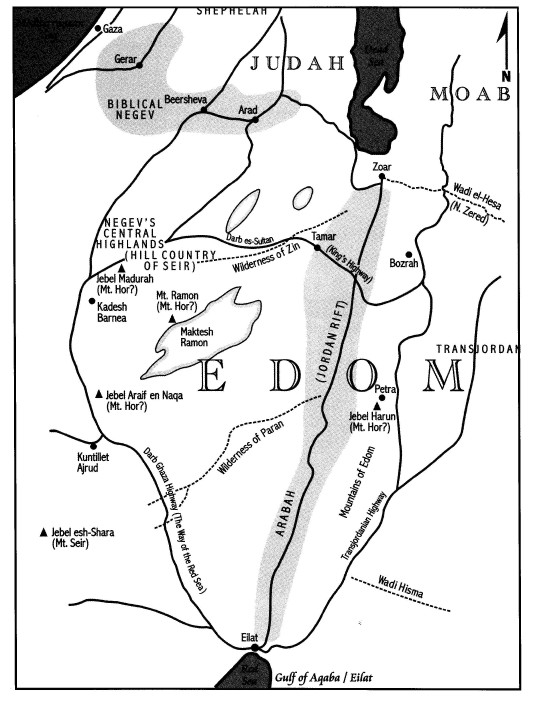
This address takes place in the eleventh month, שְׁבָט (Shevat) on the first day of the month. It is given in a place referred to by Moses as in the plain opposite Suph, between Paran, Tophel, Laban, Hazeroth, and Dizahab.. The Paran and Hazeroth here mentioned are not the Paran and Hazeroth where the people wandered and encamped (respectively) after leaving Sinai, but are different places with the same names, as was common at that time. This was in an area now called Arabah, which encompasses the Jordan valley between the Sea of Galilee all the way to the Gulf of Aqabah, the northeastern arm of the Red Sea.

(https://www.ldolphin.org/crew/fig01.jpg)
The names of the places in our text pinpoint the location where Moses spoke these words, and was likely the area known as Heshbon, which was due east of Jericho. It was at this place where Moses spoke to the people the Law he had received from God on Mt. Sinai as recorded in Exodus and Leviticus. Until this time, the people did not know this Law or what it contained. All they knew was that God spoke to Moses on the mountain and at various times thereafter, but the substance of those conversations they were not privy to. Now that Moses was speaking these words to the people, they would be without excuse, and would be expected to learn these commands and follow them as they were told.
In Deuteronomy 1:6-46, Moses recounts their journeying and their grumbling about the land the 12 spies had seen, and even about his own denial into Canaan because of his own disobedience. He continues this narrative in Deuteronomy 2:1-7, recalling how they passed by the land of their brethren Edom, the descendants of Esau. Deuteronomy 2:1-7—1 “Then we turned and journeyed into the wilderness of the Way of the Red Sea, as the LORD spoke to me, and we skirted Mount Seir for many days. 2 And the LORD spoke to me, saying: 3 'You have skirted this mountain long enough; turn northward. 4 And command the people, saying, "You are about to pass through the territory of your brethren, the descendants of Esau, who live in Seir; and they will be afraid of you. Therefore watch yourselves carefully. 5 Do not meddle with them, for I will not give you any of their land, no, not so much as one footstep, because I have given Mount Seir to Esau as a possession. 6 You shall buy food from them with money, that you may eat; and you shall also buy water from them with money, that you may drink. 7 For the LORD your God has blessed you in all the work of your hand. He knows your trudging through this great wilderness. These forty years the LORD your God has been with you; you have lacked nothing."'” This is another place where the skeptic would point to and say “Contradiction!” For if you remember, Numbers 20:14-21 recounts when the people asked for passage through the land of their brethren and were denied. But here in Deuteronomy it says they would buy food and water from them. So how do we reconcile these two things? Easily. While the king of Edom did not permit them to pass through the land, the Edomites nevertheless sold them food and water for their journey. “That still doesn't answer the contradiction!” There is no contradiction. It’s simple. While it is true the camp of Israel did not pass through the land of Edom, there were most likely small groups of people who ventured into Edom to buy food and water.
Deuteronomy 3 continues the narrative, recounting the battles the people had with Sihon king of the Amorites and Og of Bashan, and how God went before them and defeated these kings, and how God denied Moses entry into Canaan, despite his pleadings, for his disobedience at the rock of Meribah.
Deuteronomy 4:1-4—1 “Now, O Israel, listen to the statutes and the judgments which I teach you to observe, that you may live, and go in and possess the land which the LORD God of your fathers is giving you. 2 You shall not add to the word which I command you, nor take from it, that you may keep the commandments of the LORD your God which I command you. 3 Your eyes have seen what the LORD did at Baal Peor; for the LORD your God has destroyed from among you all the men who followed Baal of Peor. 4 But you who held fast to the LORD your God are alive today, every one of you.” We humans need to be reminded so many times of so many things. Which is why Moses reminded them of what happened at Ba’al-Peor (Numbers 25:1-18). The women of Moab enticed the men to lay with them in sexual idolatry of the pagan gods. And in one day 24,000 died of the plague that God sent upon them for their idolatry. “Well, that’s pretty memorable; I don’t think anybody could forget that!” Remember that in Numbers 11:1 the people complained, God burned up the outskirts of their camp, then just three verses later they complained about the manna that came down from Heaven! These were people with a very short attention span, and needed constant reminders about the power of God. So Moses reminds them of this episode where so many died because of their idolatry, and constrains them to listen to and obey the commands from God “which I teach you to observe, that you may live, and go in and possess the land which the LORD God of your fathers is giving you.” He was not simply talking just to hear his own voice, but showed his genuine concern for the people and for the name of God by entreating the people to listen to and obey the words which he was giving them. These were God’s chosen people, and how would the neighboring nations think of the name and reputation of God if these people carried on with worshipping the idols of these neighboring nations? They would not think very highly of Him if He chose people who would abandon Him.
Deuteronomy 4:5-20—5 “Surely I have taught you statutes and judgments, just as the LORD my God commanded me, that you should act according to them in the land which you go to possess. 6 Therefore be careful to observe them; for this is your wisdom and your understanding in the sight of the peoples who will hear all these statutes, and say, 'Surely this great nation is a wise and understanding people.' 7 For what great nation is there that has God so near to it, as the LORD our God is to us, for whatever reason we may call upon Him? 8 And what great nation is there that has such statutes and righteous judgments as are in all this law which I set before you this day? 9 Only take heed to yourself, and diligently keep yourself, lest you forget the things your eyes have seen, and lest they depart from your heart all the days of your life. And teach them to your children and your grandchildren, 10 especially concerning the day you stood before the LORD your God in Horeb, when the LORD said to me, 'Gather the people to Me, and I will let them hear My words, that they may learn to fear Me all the days they live on the earth, and that they may teach their children.' 11 Then you came near and stood at the foot of the mountain, and the mountain burned with fire to the midst of heaven, with darkness, cloud, and thick darkness. 12 And the LORD spoke to you out of the midst of the fire. You heard the sound of the words, but saw no form; you only heard a voice. 13 So He declared to you His covenant which He commanded you to perform, the Ten Commandments; and He wrote them on two tablets of stone. 14 And the LORD commanded me at that time to teach you statutes and judgments, that you might observe them in the land which you cross over to possess. 15 Take careful heed to yourselves, for you saw no form when the LORD spoke to you at Horeb out of the midst of the fire, 16 lest you act corruptly and make for yourselves a carved image in the form of any figure: the likeness of male or female, 17 the likeness of any animal that is on the earth or the likeness of any winged bird that flies in the air, 18 the likeness of anything that creeps on the ground or the likeness of any fish that is in the water beneath the earth. 19 And take heed, lest you lift your eyes to heaven, and when you see the sun, the moon, and the stars, all the host of heaven, you feel driven to worship them and serve them, which the LORD your God has given to all the peoples under the whole heaven as a heritage. 20 But the LORD has taken you and brought you out of the iron furnace, out of Egypt, to be His people, an inheritance, as you are this day.” No other nation in the history of planet Earth was ever called by name by the God of all creation. No other nation was given His Laws, His sacrifices, or a way to be reconciled to Him other than the people of Israel. God made no covenant with any other particular nation on Earth other than Israel. He did not covenant with the Hittites, or the Amorites, or the Canaanites or the Egyptians or the Babylonians. Only with the Israelites. This is a great thing to consider. That the God of all Creation would make a covenant with a people who were not even a nation! And if the people walked in His statutes and obeyed His commandments, the neighboring nations would consider them wise and understanding. For who has wisdom but God? Wisdom was the first of His creation (see Proverbs 8:22-31). It is God alone who gives wisdom to men; it is God alone whose wisdom created the universe, so that all the planets and galaxies do not rush here and there and crash into each other. And who has understanding but God? Who can plumb the depths of all things and know exactly how they work? Who can know how the mind of man works except he who has understanding from God?
Moses spells this out in verses 15-19. If their neighboring nations saw them worshipping created beings as they worshipped, the people of Israel would be seen as no different from them, as these neighbors worshipped all kinds of things found in nature—stars, sun, moon, cattle, creeping things. All the things Paul warned us about in Romans 1:22-23. Seeking to be thought of as the wise of the world, they showed just how foolish they really were, thinking that birds and animals and insects were to be worshipped, rather than the God who created all things, visible and invisible, and who could destroy all of creation with a snap of His fingers. Are cats longsuffering? If they cry to be fed, and you do not feed them right then and there, will they understand? Can dogs create? Can moths or beetles fulfill your needs? No. Only a fool would think so. But all of these things the pagan nations believed, and gave obeisance to these things, thinking that by doing so their lives would be more at ease. But what did these things do for these people? Nothing. What did God do for the people of Israel? He did to them and for them according to their obedience or according to their defiance.
Deuteronomy 4:25-31—25 “When you beget children and grandchildren and have grown old in the land, and act corruptly and make a carved image in the form of anything, and do evil in the sight of the LORD your God to provoke Him to anger, 26 I call heaven and earth to witness against you this day, that you will soon utterly perish from the land which you cross over the Jordan to possess; you will not prolong your days in it, but will be utterly destroyed. 27 And the LORD will scatter you among the peoples, and you will be left few in number among the nations where the LORD will drive you. 28 And there you will serve gods, the work of men's hands, wood and stone, which neither see nor hear nor eat nor smell. 29 But from there you will seek the LORD your God, and you will find Him if you seek Him with all your heart and with all your soul. 30 When you are in distress, and all these things come upon you in the latter days, when you turn to the LORD your God and obey His voice 31 (for the LORD your God is a merciful God), He will not forsake you nor destroy you, nor forget the covenant of your fathers which He swore to them.” It is not long after the death of Joshua that the people do this very thing. The book of Judges is nothing but a repeating cycle of disobedience by the people, captivity of the people, the people crying out to God, Him delivering them, their repeated disobedience and captivity, them crying out and being delivered, and so on and so forth. The histories of the kings of Israel and Judah are marked by this same pattern in the books of Kings and Chronicles. In 622BC He allows the northern kingdom of Israel to be taken captive by the Assyrians. The people of Judah learned their lesson the hard way in 587BC, when after King Josiah died—the last of the godly kings of Judah—they made his son Jehoahaz king. He was quickly deposed by the conquering Egyptians who placed his brother Eliakim (whose name they changed to Jehoiakim) on the throne, and he was carried away to Babylon by Nebuchadnezzar. His son Jehoiachin became king, and he too was carried off to Babylon, and Zedekiah (Jehoiakim’s brother) was installed by Nebuchadnezzar to be king of Judah. And Zedekiah did all the evils that were done by Jehoahaz, Eliakim, and Jehoiachin. These evil kings carried the people away in their sins with them, and the people were ultimately carried away to Babylon and the temple in Jerusalem was burned. And in 587BC God allows Judah to be taken into exile to Babylon because of their idolatry. And much like their time in Egypt, when they were obliged to raise monuments to the Egyptian Gods, they would serve false gods in whichever dispersion they were taken in. Keil and Delitzsch—
There among the heathen they would be obliged to serve gods that were the work of men's hands, gods of wood and stone, that could neither hear, nor eat, nor smell, i.e., possessed no senses, showed no sign of life. What Moses threatens here, follows from the eternal laws of the divine government. The more refined idolatry of image-worship leads to coarser and coarser forms, in which the whole nature of idol-worship is manifested in all its pitiableness. “When once the God of revelation is forsaken, the God of reason and imagination must also soon be given up and make way for still lower powers, that perfectly accord with the I exalted upon the throne, and in the time of pretended 'illumination' to atheism and materialism also” (Schultz).
Which is why Moses said at the beginning of verse 25, “When”, not “if”. These words were spoken to him by God, who knew the people would act corruptly, and make for themselves idols, and be carried away to a land they did not know and would serve the idols of this unknown (to them) land. And none of the idols they set up for themselves could stop what God was doing. BUT… Did God forget the covenants He made with Abraham, Isaac and Jacob and the people? No, He did not. For as He promised, He raised up a king, Cyrus (he was king of Persia, and defeated the Babylonians in the year 539BC), who made a proclamation and gave the Jews permission to return to the land of Judah and rebuild the temple.
The warnings are no less dire to us today. If we do not worship God, if we do not give Him His due reverence, if we do not exalt Him as the High and Omniscient Potentate, we will be reduced to worshipping those things which are no gods, the fictions of men’s minds which are good for nothing but to entertain the intellect and whims of men for a moment, but in the end can do nothing for them. The new atheists—Richard Dawkins, Neil DeGrasse Tyson, Christopher Hitchens—will join the older atheists, like Voltaire, and bow their knee before God and recognize Him as King of all Creation!
Part 2 next week