...
 The Law of God contains punishments for those who rebel against God’s righteousness. But it also contains commands that require us to do good to our neighbor. And this concept is what the apostle Paul was referring to in Romans 11:22 (NASB)—Note then the kindness and the severity of God: severity toward those who have fallen, but God's kindness to you, provided you continue in his kindness. And if we also have the words of our Lord Jesus Christ, that all of the Law hangs on two commands, Matthew 22:37-40—“You shall love the LORD your God with all your heart, soul, mind and strength…you shall love your neighbor as yourself. On these hang all the Law and the prophets.” We are to love and fear God—that we may not sin against Him. We love our neighbor—that we might not do him wrong. And so we see what Paul meant by the kindness and severity of God—kindness to those who love Him; severity to those who rebel against Him. And today’s text deals more with the severity of God toward those who despise Him and His righteousness.
Exodus 22:20, 28; Exodus 23:1-3, 6-8—“20 He who sacrifices to any god, except to the LORD only, he shall be utterly destroyed…28 You shall not revile God, nor curse a ruler of your people…23:1 You shall not bear a false report; do not join your hand with a wicked man to be a malicious witness. 2 You shall not follow the masses in doing evil, nor shall you testify in a dispute so as to turn aside after a multitude in order to pervert justice…6 You shall not pervert the judgment of your poor in his dispute. 7 Keep yourself far from a false matter; do not kill the innocent and righteous. For I will not justify the wicked. 8 And you shall take no bribe, for a bribe blinds the discerning and perverts the words of the righteous.” We have three principles in these verses. First—the most obvious—we are to worship God and God alone. The second is that we are to respect those that God has placed in positions of authority. The third principle is that we are not to put ourselves in a position of giving false testimony and condemning an innocent person. And we see the second and third principles displayed in the gospels.
To start, let’s look at Exodus 22:20, 28—“20 He who sacrifices to any god, except to the LORD only, he shall be utterly destroyed…28 You shall not revile God, nor curse a ruler of your people.” The first command: simple. Do not sacrifice anything to any god but God. On the other hand, the second command says to not blaspheme God or curse, as it says a ruler of your people.
If you’ve ever heard the word ‘theocracy’, it simply means a form of government with God as its ruler. (Actually, when you get right down to it, the universe is a ‘theocracy’. It is ruled and governed by God. He simply lets men hold some of the lesser offices. Like, President). God intended for Israel to be a theocracy. God was to be their only king. And God had placed men in positions of authority to act in His name and in His authority. In some translations these are called ‘judges’ or ‘magistrates’. God did not intend for the people to have a king over them—they were to be ruled by God and God alone. We know that down the road the people cried out for God to give them a king like the pagan nations had. And like the saying goes, be careful what you wish for. Because we know from the history of the kings of Israel and the kings of Judah that God gave them what they wanted. But in the society that the Israelites lived under until the time after the death of Joshua, the people were ruled by God.
Well, to despise the authority of the high priest and the government of God was to, in fact, despise God. Hebrews 10:28—Anyone who has rejected Moses' law dies without mercy on the testimony of two or three witnesses. Despising Moses’ law includes despising those who administer that law. And during the time when Christ walked the earth, this Law was administered by a body of men called the Sanhedrin. Christ also called it “the council” in some places. The Hebrew term that was the equivalent of the term “Sanhedrin” was “K’nishta”. Over time that term morphed into one that we actually hear sometimes today. You may be watching the news and hear them refer to the “Knesset”. This is the legislative branch of the Israeli government. It would be like our House of Representatives and the Senate rolled into one. Anyway, the most well-known trial that ever took place before that “Knesset” or “K’nishta” or “Sanhedrin” took place about 2000 years ago. Anybody know who the defendant was? It was before these magistrates, these “rulers” as they're called in Exodus 22, that Christ was brought to trial.
All of the prohibitions in today’s text were put on display in the trial of Jesus. We have people bearing a false report. People who joined their hands with the wicked to be a malicious witness. People who followed the masses in doing evil. We see men testifying in a dispute so as to pervert justice. And of course we see the murder of the innocent and righteous. But the first thing we see is Christ’s obedience to the Law by not reviling a ruler of the people. Matthew 26:57-64—57 And those who had laid hold of Jesus led Him away to Caiaphas the high priest, where the scribes and the elders were assembled. 58 But Peter followed Him at a distance to the high priest's courtyard. And he went in and sat with the servants to see the end. 59 Now the chief priests, the elders, and all the council sought false testimony against Jesus to put Him to death, 60 but found none. Even though many false witnesses came forward, they found none. But at last two false witnesses came forward 61 and said, "This fellow said, 'I am able to destroy the temple of God and to build it in three days.'" 62 And the high priest arose and said to Him, "Do You answer nothing? What is it these men testify against You?" 63 But Jesus kept silent. And the high priest answered and said to Him, "I put You under oath by the living God:—in other words, “I put you under oath by You”—Tell us if You are the Christ, the Son of God!" 64 Jesus said to him, "It is as you said. Nevertheless, I say to you, hereafter you will see the Son of Man sitting at the right hand of the Power, and coming on the clouds of heaven." So here we have this farce of a trial, presided over by the rulers of the people. And the means they used to carry out this trial went against all the rules that were in place for pretty much any trial, but especially a trial that involved the potential for the defendant to be put to death.
There was a fellow named Simon Greenleaf, and he was the dean of the Harvard Law School many, many years ago. He became a very skilled writer in defense of the truth of Christ. He wrote a book called "The Testimony of the Evangelists," and this book includes a whole section by a gentleman named Joseph Salvador on how the Sanhedrin was to conduct a trial involving the death penalty. I won’t reproduce it here, but I will share with you the boiled-down, condensed version from John MacArthur—“In the Jewish trial of Jesus Christ, they violated every single law of justice and jurisprudence known to them. They violated every single one of them willfully so that the trial of Jesus Christ is THE most unjust trial in human history…the motto of the Sanhedrin was this: ‘The Sanhedrin is to save, not to destroy life’…No criminal trial could be carried through the night, this one was. The judges who condemned a criminal had to have a day in between before the execution and they had to fast all day, they didn't. They killed Jesus the same day...There had to be defense, there was no defense…And that and many other illegalities make up a list of things they did to violate the laws that they themselves affirmed.”
The high priest has leveled this accusation against Christ—a lie that even the high priest knows is false. Jesus could have very easily said, “You're a liar and a crook! Now let Me go!” But He didn’t. Why? Because God said “You shall not curse a ruler of your people.” If He had rebuked the high priest, He would have broken the Law of God that He was sent to fulfill. But he didn’t have to accuse them—they accused themselves. His silence fulfilled not only the Law, but also the words of Isaiah 53:7 (NASB)—He was oppressed and He was afflicted, yet He did not open His mouth; like a lamb that is led to slaughter, and like a sheep that is silent before its shearers, so He did not open His mouth. There is another passage that is fulfilled in Jesus’ response, and that is Psalm 38:12-14 (ESV)—12 Those who seek my life lay their snares; those who seek my hurt speak of ruin and meditate treachery all day long. 13 But I am like a deaf man; I do not hear, like a mute man who does not open his mouth. 14 I have become like a man who does not hear, and in whose mouth are no rebukes.
Now, the Sanhedrin were not the only ones who condemned themselves. Exodus 23:1-3, 6-8—“1 You shall not bear a false report; do not join your hand with a wicked man to be a malicious witness. 2 You shall not follow the masses in doing evil, nor shall you testify in a dispute so as to turn aside after a multitude in order to pervert justice…6 You shall not pervert the judgment of your poor in his dispute. 7 Keep yourself far from a false matter; do not kill the innocent and righteous. For I will not justify the wicked. 8 And you shall take no bribe, for a bribe blinds the discerning and perverts the words of the righteous.” Everybody involved in the trial of Christ did everything they could to condemn the Man. And they all wound up condemning themselves. Listen to what these witnesses testified.
Mark 14:57-59—57 Then some rose up and bore false witness against Him, saying, 58 "We heard Him say, 'I will destroy this temple made with hands, and within three days I will build another made without hands.'" What they were trying to accuse Him of was saying that He could—and would—destroy the temple in Jerusalem and rebuild it in three days. Now, the temple had been under construction for nearly 46 years when these events took place. But He did not say He would destroy the temple—that is, the building that we talked about last week that was eventually destroyed by the Romans. He actually said that they would destroy “this temple.” John 2:19-21—19 Jesus…said to them, "Destroy this temple, and in three days I will raise it up." 20 Then the Jews said, "It has taken forty-six years to build this temple, and will You raise it up in three days?" 21 But He was speaking of the temple of His body. When someone wants to believe a lie, they will latch onto any little tidbit they can. And here, they really go out on a limb, testifying that Jesus really claimed to be able to rebuild the temple at Jerusalem in three days. (Well, He could have, but that was not what He was claiming.) If they had really believed He was merely a man, it would have been foolishness for them to think He could have ever even made this claim, let alone try to pull it off. Which is why He didn’t answer. He knew His hour had come—the hour in which He would glorify God, and the hour in which man would condemn himself.
Now, in the time we have left let’s ask the question, “What does the commandment from Exodus 22-23 mean for us today? After all, we don’t live in a theocracy.” Well, I'm glad you asked. What it means is this: That when a government makes a law we are to obey it. Because whether the government is based on God’s word, or whether it is based on tyranny and oppression, that government receives its authority from God Himself. Now, someone may say, “Well, what about the government in countries where they arrest and torture and execute Christians?” God knows what they do. God has not forgotten. But it is in those countries that God is most glorified through His people. Because when His people are brought to trial, and ordered to renounce the name of Christ, and they stand firm and do not deny, they glorify God.
Romans 13:1-3—1 Let every soul be subject to the governing authorities. For there is no authority except from God, and the authorities that exist are appointed by God. 2 Therefore whoever resists the authority resists the ordinance of God, and those who resist will bring judgment on themselves. 3 For rulers are not a terror to good works, but to evil. Do you want to be unafraid of the authority? Do what is good, and you will have praise from the same. We don’t have time to do an in-depth study on this passage, but here is what Paul is saying in a nutshell. Whatever governments exist are appointed by God. That’s what he’s saying in verse 1. In verse 2, he is repeating the command found in Exodus 22:28, to not curse the ruler of your people. And in fact, he tells us to pray for those men in 1st Timothy 2:1-2—1 Therefore I exhort first of all that supplications, prayers, intercessions, and giving of thanks be made for all men, 2 for kings and all who are in authority, that we may lead a quiet and peaceable life in all godliness and reverence. Now, when we get to Romans 13:3 we may be tempted to say “Now wait a minute! Communist China terrorizes those who confess Christ!” That’s not the point Paul is making. The ESV says it best, Romans 13:3 (ESV)—For rulers are not a terror to good conduct, but to bad. That’s why he asks if we want to be unafraid of our government? Do you really want the government to not enforce the laws? Ever notice how the people who scream the loudest that the police are corrupt and the police are this or that—who are the first people those folks call when someone’s broken into their house?
A couple more passages about government being appointed by God. Colossians 1:16—For by Him all things were created that are in heaven and that are on earth, visible and invisible, whether thrones or dominions or principalities or powers. 1st Peter 2:13-15—13 Therefore submit yourselves to every ordinance of man for the Lord's sake, whether to the king as supreme, 14 or to governors, as to those who are sent by him for the punishment of evildoers and for the praise of those who do good. 15 For this is the will of God, that by doing good you may put to silence the ignorance of foolish men. And Jesus Himself said the very same thing—the very government that would nail Him to the cross was appointed and ordained by God. John 19:10-11—10 Then Pilate said to Him, "Are You not speaking to me? Do You not know that I have power to crucify You, and power to release You?" 11 Jesus answered, “You could have no power at all against Me unless it had been given you from above.” John Gill—“Meaning, not from the Jewish Sanhedrim…nor from the Roman emperor, or senate of Rome, the higher powers; by whom Pilate was made governor of Judea… but reference is made to the place from where he came, and to the decree and council of God above, and the agreement between the eternal three in heaven. Christ speaks of a power Pilate had against Christ, that is, of taking away his life; he had no lawful power to do it at all; nor any power, right or wrong, had it not been given him by God.”
Jesus Christ is Lord. Amen.
 In our journey through Exodus, we come to a place where the Pharisees who lived during the time when Christ walked the earth were in clear and direct violation of this Law that they were clinging to for their salvation. And in the gospels this is a point on which Jesus, far from being the poster child for the “Let’s all just sit down and discuss our differences and come to a mutual understanding so we can worship God in our own way” mentality that is currently popular among many “evangelical” churches, really lashes out at the Pharisees’ religion and pokes His holy finger into their unrighteous heart and shows them that they are false worshippers of God. Exodus 22:21-24—“21 You shall neither mistreat a stranger nor oppress him, for you were strangers in the land of Egypt. 22 You shall not afflict any widow or fatherless child. 23 If you afflict them in any way, and they cry at all to Me, I will surely hear their cry; 24 and My wrath will become hot, and I will kill you with the sword; your wives shall be widows, and your children fatherless.” In verse 21, God reminds them, yet again, that they were strangers and foreigners in the land of Egypt, and they still remembered, no doubt, the pain and suffering and humiliation they endured for those 400 years—therefore they shall be kind to anyone who is a stranger among them. Since God showed them mercy in bringing them out of Egypt, they are to show mercy to strangers that come in among them.
Now, in verses 22-24, this is where we are going to bring the Old Testament into the New. And in this passage God shows that He is not simply some hot-headed ill-tempered despot who simply looks for people to destroy if He doesn’t get His morning coffee. Exodus 22:22—“You shall not afflict any widow or fatherless child.” John Wesley—
“Ye shall not afflict the widow or fatherless child - That is, ye shall comfort and assist them, and be ready upon all occasions to shew them kindness. In making worthy demands from them, their condition must be considered who have lost those that should protect them: they are considered to be unskilled in business, destitute of advice, fearful, and of a tender spirit; and therefore must be treated with kindness and compassion, and not to be taken advantage of, nor have any hardship put upon them, which a husband or a father would have sheltered them from.”
Did these people have Social Security? Did they have DCS? Child labor laws? Did they have 401(k) programs and pensions? The widows and fatherless were at the mercy of any who could—and many times would—take advantage of them and make their plight even worse. There were no safeguards for women who lost their husbands or children who lost their fathers. Well, actually, they did have a safeguard—God. God was their safeguard. If noone else would protect them or care for them, God would. And would He ever. Listen to what He says in Exodus 22:23-24—“23 If you afflict them in any way, and they cry at all to Me, I will surely hear their cry; 24 and My wrath will become hot, and I will kill you with the sword; your wives shall be widows, and your children fatherless.” If the widow or fatherless had no one to fight for them, God would fight for them. Is it a good idea to fight God?
All throughout the Scriptures, time and time again we see passages that deal with how we are to treat the widow and the fatherless. Deuteronomy 10:17-18—“17 For the LORD your God is God of gods and Lord of lords, the great God, mighty and awesome, who shows no partiality nor takes a bribe. 18 He administers justice for the fatherless and the widow, and loves the stranger, giving him food and clothing.” Isaiah 1:17—“Learn to do good; seek justice, rebuke the oppressor; defend the fatherless, plead for the widow.” Ezekiel 22:6-7—“6 Look, the princes of Israel: each one has used his power to shed blood in you. 7 In you they have made light of father and mother; in your midst they have oppressed the stranger; in you they have mistreated the fatherless and the widow.” God stands up when those whom He has chosen are afflicted, oppressed and persecuted. In fact, He did that for you and me. He chose us in Him, and He saved us when we couldn’t save ourselves. Romans 5:6—For when we were still without strength, in due time Christ died for the ungodly. And from a human perspective, the most helpless and most powerless among us are orphans and widows. And God demands that no one place even heavier burdens upon them.
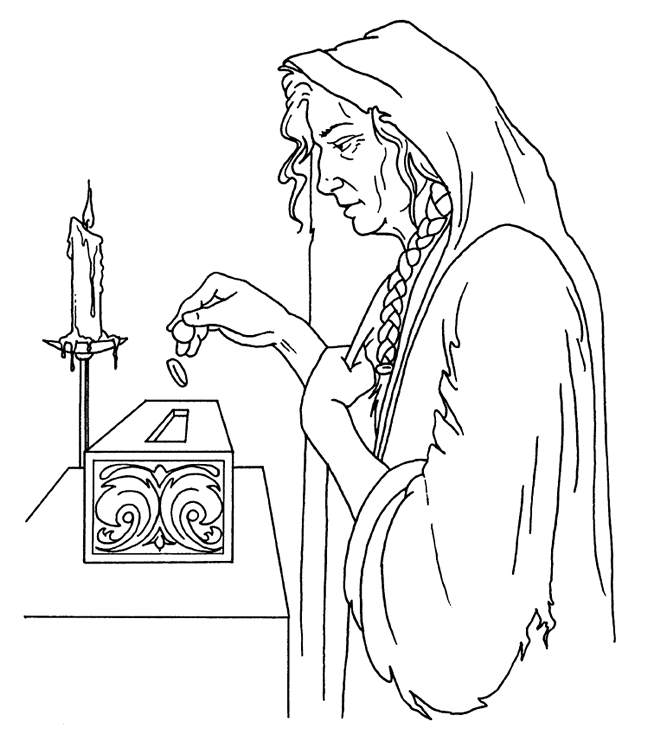
And yet by the time the Pharisees came to prominence that is exactly what they did. They built their whole system upon treading down the most powerless of the most powerless. Not just women and children—widowed women and fatherless children. And in His last days before He was crucified, Jesus saved some of His harshest words for those who used the cloak of religion to get wealthy. Turn with me to Luke 20:45. This is an exchange between Christ and the Pharisees—one that we often hear preached and taught as a passage about selfless giving. About “giving all you have to God.” But that is not the reason this exchange is included in the Scriptures. It’s the story of the widow that puts her last two pennies into the collection box. But let’s read it in its proper context. Because this is not a lesson on “sacrificial giving.” It is actually an example of the Pharisees “devouring widows’ houses” as Jesus calls it. This is another example of chapter divisions that they didn’t quite get right. Because this exchange starts at the end of Luke 20, and runs over into Luke 21. Luke 20:45-47—45 Then, in the hearing of all the people—He did not come and take them aside, and say, “Now, guys, I want to tell you something but I don’t want to embarrass you, so let’s go somewhere we can talk privately.” In the hearing of all the people, He said to His disciples, 46 "Beware of the scribes, who desire to go around in long robes, love greetings in the marketplaces, the best seats in the synagogues, and the best places at feasts, 47 who devour widows' houses, and for a pretense make long prayers. These will receive greater condemnation." This is actually a parallel of the list of woes that Christ lays down for the scribes and Pharisees in Matthew 23. And if anyone ever tells you “We need to be more like Jesus and just get along with everybody”—take them to Matthew 23.
The context of this passage is Jesus rebuking the Pharisees for their extravagant lifestyles. He is showing the world—in the hearing of all the people—just how the Pharisees are very pretty on the outside—but very ugly on the inside. And after He gets done scolding these Pharisees for being hypocrites, and snakes, and whitewashed tombs and blind guides and so on, then we get to the widow putting her money into the collection. Luke 21:1-4—1 And He looked up and saw the rich putting their gifts into the treasury, 2 and He saw also a certain poor widow putting in two mites. A ‘mite’—most other translations render it “two copper coins.” It was the smallest of the smallest coins at that time. It would be like if we had a half-penny. 3 So He said, "Truly I say to you that this poor widow has put in more than all; 4 for all these out of their abundance have put in offerings for God, but she out of her poverty put in all the livelihood that she had." Now notice something here. Jesus does not once commend her for any “selfless giving.” He does not say, “Look at what this woman has done, and you do the same.” He was, in fact, condemning the religious practice of the scribes and Pharisees, who taught that you had to give to the temple if you wanted God’s blessing. Jesus says “NO!! God does not want you to give up the last two pennies you have in order to give to Him.” If God demands that widows put in their last two copper coins and go home to starve to death, would that not mean that He would be guilty of “afflicting widows”? And if God condemns those who afflict widows, and if God wants the last two pennies a widow has to her name, then wouldn’t God be condemning Himself?
The first time I ever heard this passage in Luke explained in this was by John MacArthur. Listen to what he said—
“One thing I do know is this, the Lord does not expect you to give 100 percent of what you have so that you have absolutely nothing left. But that's the only obvious principle here if you're going to draw a principle. Besides, why would you inject the principle about giving in a context like this? This is no place to interject, ‘Oh by the way, a few words on giving’…The Lord makes no comment about giving except that she gave more than everybody else relative to what she had. She is not commended. They are not condemned. No one's attitude or spirit in the giving is discussed. And no principle regarding giving is drawn by our Lord. The narrative is not intended to deal with any of those matters. The reason the Lord doesn't say anything about it is that's not what it's about. And if you look at the context before and after, this is all about the condemnation of wicked spiritual leaders and a corrupt religious system that is about to be destroyed.”
And I would agree 100% with his assertion. The Pharisees had built their religion on the back of the poor, demanding that they give to the temple so these religious leaders—under the guise of “giving for the glory of God”—could live in luxury while crushing the poor under their feet.
Again, Jesus never commends her for her generosity. She is, in fact, contributing to this corrupt system. The blind may have been leading the blind—but even those followers were blind. His point here is actually to condemn that corrupt system which was preying on widows and the poor. Because think about it—the Pharisees at the time were like what we have on TBN today. They were teaching, 2000 years ago, that if you were poor it was because you were under a curse from God and you needed to give “the Man of God” all your money. Just like Fred Price or Paula White or Steve Munsey today. And it was that system that Jesus came to destroy. Which is why He goes on to say, Luke 21:5-6—5 Then, as some spoke of the temple, how it was adorned with beautiful stones and donations—donations that included the two little copper coins that the widow threw in—5 Then, as some spoke of the temple, how it was adorned with beautiful stones and donations, He said, 6 "These things which you see—the days will come in which not one stone shall be left upon another that shall not be thrown down." And it came to pass that in 70 AD, not even 40 years after Christ’s death and resurrection, the Roman general Titus surrounded Jerusalem and burned it to the ground, the temple being destroyed in the process.
Josephus, the Jewish historian who lived around the end of the first and beginning of the second century AD, wrote this about the bloodshed within the temple:
“Now round about the altar lay dead bodies heaped one upon another; a great quantity of their blood ran down the steps going up to the altar. Also the dead bodies that were slain above, on the altar, fell down.”
Thus was fulfilled the words of the Law, which said Exodus 22:22-24—“22 You shall not afflict any widow or fatherless child. 23 If you afflict them in any way…24 My wrath will become hot, and I will kill you with the sword.”
And just to finish the point, another passage which speaks about the widows and fatherless is James 1:27 (NASB)—Pure and undefiled religion in the sight of our God and Father is this: to visit orphans and widows in their distress, and to keep oneself unstained by the world. Albert Barnes—
“To go to see, to look after, to be ready to aid them. This is an instance or example of what true religion will do, showing that it will lead to a life of practical benevolence. It may be remarked that this has always been regarded as an essential thing in true religion; because this is an imitation of God, who is 'a father of the fatherless, and a judge for the widows in his holy habitation,' (Psalm 68:5); and who has always revealed himself as their friend.”
When we talk about the books of the NT—whether the gospels or the epistles—they all had an intended audience. Paul wrote Philippians to a church which was made up of those who had lived under Roman government and culture, but were now worshipping God. He wrote Ephesians to a church that was surrounded by Greek pagan worship. Peter wrote his two letters for Jewish readers. And like the apostle Peter, the main audience that James was writing to was Jewish Christians. Christians who had grown up hearing and learning the Law. And, yes, even those parts of the Law concerning the widows and fatherless. In fact, that’s what he means when he describes himself in James 1:1—James, a bondservant of God and of the Lord Jesus Christ, To the twelve tribes which are scattered abroad. And he really corrects their thinking about religion, and shows them that true religion is not tied up in fancy garments and keeping feasts. James is saying that, yes, religion does include “keeping oneself unstained by the world.” But, one must never neglect to help the most helpless of the helpless.
Let me finish up with this comment from Dr. MacArthur about that passage in Luke—
“How would you feel…if you saw a destitute widow who only had two coins left to buy her food for her next meal give those two coins to a religious system…? You would say, ‘Something is wrong with that system when that system takes the last two coins out of a widow's hand.’ That's what you would say and you would be right to say that….how would you feel if you saw a destitute, impoverished person give to her religion her last hope for life to go home perhaps and die? You'd be sick. You'd feel terrible. You would be repulsed. Any religion that is built on the back of the poor is a false religion. What a sad, misguided, woeful, poor victimized lady. It's tragic, painful. And I think that's exactly how Jesus saw it.”
Jesus Christ is Lord.
Amen.


 Just to kind of give you a preview of what’s in the near future; in a couple weeks when we get to chapter 23 we’re going to skim over the three main festivals that were to be kept each year—Passover; the Feast of Firstfruits; and the Feast of Ingathering. We won’t really go in-depth; we’ll save the deeper study for when we get to those parts of Leviticus. Then Exodus 24, we will see God make His covenant with Moses and the people of Israel. Then when we get to chapters 25-28, these are the chapters that cover the building of the tabernacle and the making of the priestly garments, and for those chapters I found a really good computer-animated video of these things and we will use that rather than have me stand here and try to give you the idea of what they looked like. And then chapter 30 details the consecration, or sanctification, or the setting apart of the tabernacle for the worship of God, and we will see some really clear pictures of Christ and our own salvation through these words.
So, with all that being said, let’s read Exodus 22:16-17—“16 If a man entices a virgin who is not betrothed, and lies with her, he shall surely pay the bride-price for her to be his wife. 17 If her father utterly refuses to give her to him, he shall pay money according to the bride-price of virgins.” This was the original command for the “shotgun wedding”—you want to sleep with my daughter, you better be ready to marry her. The “bride-price” was a form of what is called a “dowry.” A dowry is defined as “The money, goods or estate which a woman brings to her husband in marriage.” In the day and age we live in, guys think it’s “cool” to take a girl’s virginity. God doesn’t. And so, God gave this command that if you take a girl’s virginity, you would then pay her father the “bride-price”, or dowry if you will. That “bride-price” was fifty shekels of silver (not sure what that would be today), and you have yourself a wife.
And guess what? If you found out down the road that she ain't all you thought she would be—tough luck, you're married to her for life. Deuteronomy 22:28-29—“28 If a man finds a young woman who is a virgin, who is not betrothed…and lies with her, and they are found out, 29 then the man who lay with her shall give to the young woman's father fifty shekels of silver, and she shall be his wife because he has humbled her; he shall not be permitted to divorce her all his days.” Sorry pal, you're stuck with her. Now, if they are found out, and daddy says, “Son, I don’t want you anywhere near my daughter ever again,” then you still had to pay the fifty shekels, and you didn’t get the girl. However, the penalty for sleeping with a woman who was betrothed to another man was much worse than if you were caught with a virgin. Listen to Deuteronomy 22:23-24—“23 If a young woman who is a virgin is betrothed to a husband, and a man finds her in the city and lies with her, 24 then you shall bring them both out to the gate of that city, and you shall stone them to death with stones.” Again, these acts of wickedness—whether it’s stealing or sleeping with a man’s daughter—these things get real expensive. And as we continue studying these statutes we keep seeing, over and over, just how seriously God thinks of sin. He doesn’t just say, “Well, OK, you feel bad about what you did; that’s punishment enough.” He attaches a pretty hefty price to these things.
And next we see the price that God attaches to another act of wickedness, Exodus 22:18—“You shall not permit a sorceress to live.” The KJV uses the word “witch.” God says in another place, Leviticus 20:27—“A man or a woman who is a medium, or who has familiar spirits, shall surely be put to death; they shall stone them with stones. Their blood shall be upon them.” What do we normally think of when we hear words like ‘sorcery’ and ‘witchcraft’? We think of “Hocus-Pocus, abracadabra”. Know what the word “abracadabra” means? It’s actually Aramaic, which was another Semitic language that was very similar to Hebrew. “Abra means ‘to create’ and cadabra means ‘as I say’, ultimately when merging the two words abracadabra means in Aramaic is ‘create as I say’.” (Source: Wikipedia) So, basically, when someone says “abracadabra” they are making themselves God. Now notice how this command is worded. Most of the commands up until now have been “If a person does this, they shall be put to death” or “If he does this he shall surely die.” But listen to the words God uses here—“You shall not permit a sorceress to live.” He is commanding the people that when they find a sorceress—or sorcerer, for that matter—they are hereby commanded to put that one to death.
Think about it. Where had they just spent the last 400 years? Pharaoh surrounded himself with magicians and fortune-tellers. And in fact, these magicians had power to “create illusions” of their own. Exodus 7:11-12—11 But Pharaoh also called the wise men and the sorcerers; so the magicians of Egypt, they also did in like manner with their enchantments. 12 For every man threw down his rod, and they became serpents. There are some who do indeed have power to create illusions, and even perform many signs and wonders, and even “read people’s minds”—but where does their power come from? 2nd Thessalonians 2:9—The coming of the lawless one is according to the working of Satan, with all power, signs, and lying wonders. Two examples of sorcery in the book of Acts, first we have Acts 8:9-11—9 There was a certain man called Simon, who previously practiced sorcery…10 to whom they all gave heed, from the least to the greatest, saying, “This man is the great power of God.” 11 And they heeded him because he had astonished them with his sorceries for a long time. Then we have the young woman in Acts 16:16—16 Now it happened, as we went to prayer, that a certain slave girl possessed with a spirit of divination met us, who brought her masters much profit by fortune-telling. So we can see, even from Scripture, that there are some who have power to do these things. BUT—we are commanded to put people like that far away from us. Isaiah 8:19-20—19 And when they say to you, "Seek those who are mediums and wizards, who whisper and mutter," should not a people seek their God? Should they seek the dead on behalf of the living? 20 To the law and to the testimony! Keil and Delitzsch—
“What an unnatural thing, for the people of YHVH to go and inquire, not of their own God, but of such heathenish and demonic deceivers and victims as these! What blindness, to consult the dead in the interests of the living!”
Now, this could be a place to talk about the errors of the Roman Catholic system who teach that we should seek the assistance of dead saints, and Mary the mother of Christ—but we’ll save that for another day.
I do, however, want to talk about another passage of Scripture that is related to this subject, and that is 1st Samuel 28:5-12—5 When Saul saw the army of the Philistines, he was afraid, and his heart trembled greatly. 6 And when Saul inquired of the LORD, the LORD did not answer him, either by dreams or by Urim or by the prophets. 7 Then Saul said to his servants, "Find me a woman who is a medium, that I may go to her and inquire of her." And his servants said to him, "In fact, there is a woman who is a medium at En Dor." 8 So Saul disguised himself and put on other clothes, and he went, and two men with him; and they came to the woman by night. And he said, "Please conduct a séance for me, and bring up for me the one I shall name to you." 9 Then the woman said to him, "Look, you know what Saul has done, how he has cut off the mediums and the spiritists from the land. Why then do you lay a snare for my life, to cause me to die?" 10 And Saul swore to her by the LORD, saying, "As the LORD lives, no punishment shall come upon you for this thing." 11 Then the woman said, "Whom shall I bring up for you?" And he said, "Bring up Samuel for me." 12 When the woman saw Samuel, she cried out with a loud voice. Now, three questions that have been debated back and forth for these last couple thousand years are— (1) Was that really Samuel? Yes it was. (2) Did this woman really have the power to raise the dead and speak to them? I would say no, she did not. If you look at verse 12, it says she cried out with a loud voice. This had obviously either never happened before, or she saw something completely different from the familiar spirits she had seen before. (3) How did she see Samuel? Here’s what I think happened. Saul, was being disobedient to God. Had been for quite some time. God had removed His favor from him, and God was not speaking to Saul. So Saul goes against the commands of God and consults this witch. And what happened, I think, was that God sent Samuel to speak to Saul, God bringing up the prophet to speak for God even from beyond the grave. Adam Clarke—
“Strange that a man, who had banished all witches from the land…should now have recourse to them as the only persons in whom he could safely put his confidence in the time in which YHVH had refused to help him!”
Under the Law the people were commanded to put such a woman to death.
Exodus 22:19-20—“Whoever lies with an animal shall surely be put to death.” This command is repeated in Leviticus 20:15-16—“15 If a man mates with an animal, he shall surely be put to death, and you shall kill the animal. 16 If a woman approaches any animal and mates with it, you shall kill the woman and the animal. They shall surely be put to death. Their blood is upon them.” Bestiality is such a vile, filthy, reprehensible and wicked thing that anyone who has sex with an animal must be considered to have completely thrown off any sense of respect for the natural order of things and for the image of God in which they were created. Whomever a person gives themselves over to, they are one flesh with that person. And when a man or woman gives themselves over to an animal, they are joining the image of God to a brute beast. Not only that, but consider also the gods of the Egyptians. What kind of form did most of them have? Most of them were half beast and half human. Bestiality was a form of pagan worship at the time, and in many cases it may have been an attempt to create a living form of the images and statues that they worshipped. And it was for that reason that God ordered the person who engaged in such an act to be put to death.
Now, we’re gonna skip ahead to verses 25-27. There’s a good reason we’re doing this. I got started on verses 21-24, which deal with how the people were to treat widows and orphans, and there’s a really good lesson there about Jesus and His dealings with the Pharisees, and how they treated widows and orphans that I think it would be best if we took a little time with it next week and didn’t try to rush through it. So, Exodus 22:25—“If you lend money to any of My people who are poor among you, you shall not be like a moneylender to him; you shall not charge him interest.” If you lent money to your neighbor, you were not to charge him interest. Not simple interest, not compound interest—not ANY interest. Every source I've read comes to the same conclusion; that if I lend Richard $10, then all I should expect in return is $10. Not $10 plus 0.5% interest. This brings us to the moneychangers at the temple when Jesus came into Jerusalem—they were guilty of usury. This is what they did. The people would come from all over the world to keep the Passover at Jerusalem. Of course, they couldn’t carry all the animals they would need for the sacrifices, and even if they did, those who examined their sacrifice would always find some flaw with it, so just to be helpful, they would have certified, pre-owned sheep and doves to sell there.
This brought up another problem. The only currency you could use to buy these animals was Jewish currency. And it would just so happen that at the time of Passover, the exchange rate just happened to favor the moneychangers. What that means, then is they were charging their fellow Jews interest. Usury. This was in fact a violation of another command, Leviticus 25:35-37—“35 If one of your brethren becomes poor, and falls into poverty among you, then you shall help him, like a stranger or a sojourner, that he may live with you. 36 Take no usury or interest from him; but fear your God, that your brother may live with you. 37 You shall not lend him your money for usury, nor lend him your food at a profit.” And what did Jesus say about these guys? Matthew 21:12-13—12 Then Jesus went into the temple of God and drove out all those who bought and sold in the temple, and overturned the tables of the money changers and the seats of those who sold doves. 13 And He said to them, "It is written, 'My house shall be called a house of prayer,' but you have made it a 'den of thieves.'" Albert Barnes—
“It became, therefore, a matter of convenience to have a place where the Roman coin might be exchanged for the Jewish half shekel. This was the 'professed' business of these men. Of course, they would demand a small sum for the exchange; and, among so many thousands as came up to the great feasts, it would be a very profitable employment, and one easily giving rise to much fraud and oppression.”
Thus, the Pharisees, in their quest for money and luxury, were in clear violation of the very Law they were seeking to be justified by.
Now, Exodus 22:26-27—“26 If you ever take your neighbor's garment as a pledge, you shall return it to him before the sun goes down. 27 For that is his only covering, it is his garment for his skin. What will he sleep in? And it will be that when he cries to Me, I will hear, for I am gracious.” This command is expanded in Deuteronomy 24:10-13—“10 When you lend your brother anything, you shall not go into his house to get his pledge. 11 You shall stand outside, and the man to whom you lend shall bring the pledge out to you. 12 And if the man is poor, you shall not keep his pledge overnight. 13 You shall in any case return the pledge to him again when the sun goes down, that he may sleep in his own garment and bless you; and it shall be righteousness to you before the LORD your God.” What they would do is this: if I owed you $100, you would take my coat as a pledge. During the day, you would hold on to it, until that day when I paid off that debt. But, if it took more than a day for me to pay that debt, then every night you would give me back my coat. Now, we know it gets really, really hot in the desert during the daytime. But what happens at night? It gets really, really cold. And in order that the poor person who carries that debt would not suffer a greater imposition, it was returned to him at sundown so that he may not freeze to death out in the desert. This command is similar to one in Deuteronomy 24:6—“No man shall take the lower or the upper millstone in pledge, for he takes one's living in pledge.” In either of these cases—holding their coat or taking their millstone—that was a form of holding the person hostage until they paid off that debt. The ‘millstone’ was what the family used to grind their wheat or corn to make bread to eat. John Gill—
“If his mill or millstones are pawned, he cannot grind his corn, and so he and his family must starve: and in those times and countries they did, as the Arabs do to this day, as Dr. Shaw relates, ‘…these millstones being portable, might be the more easily taken for pledges, which is here forbidden; and this includes any other thing on which a man's living depends, or by which he gets his bread.”
Next week: widows and orphans
Jesus Christ is Lord. Amen.
 ...
...